


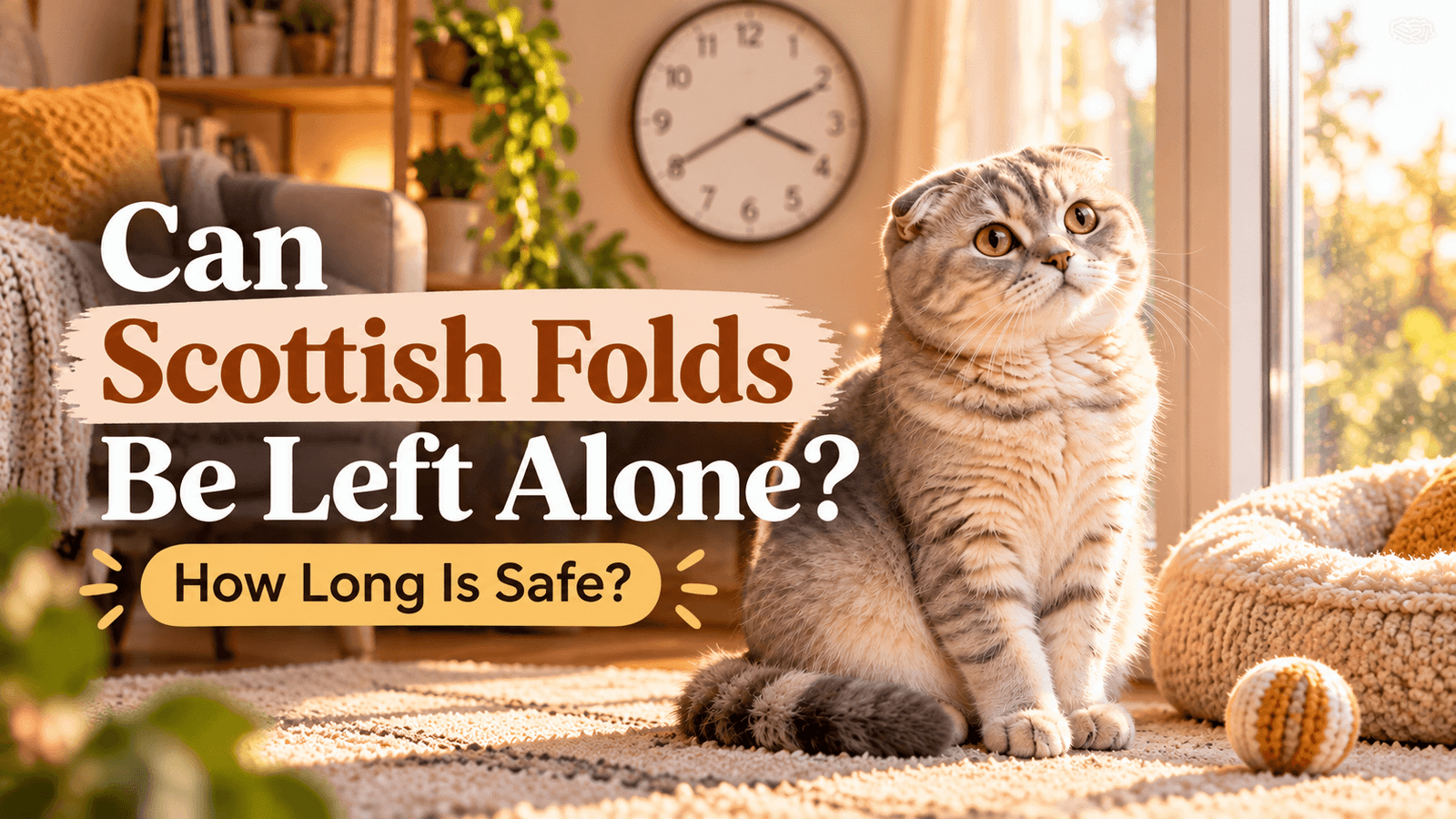
Can Scottish Folds Be Left Alone?
Yes, a healthy adult Scottish Fold can usually be left alone for part of the day. General veterinary guidance suggests that many healthy adult cats can manage around 8 to 12 hours alone, but this is not a proven Scottish Fold specific time limit. Age, health, personality, routine, and how often your cat is left alone all matter.
Scottish Folds are also known for being close to their families. The International Cat Association describes them as intelligent, inquisitive, and loyal cats that often follow family members from room to room. That does not mean every Fold will become distressed when you leave for work, but it does mean their social side should be considered.
The most useful question is not simply, “Can I leave my Scottish Fold alone?”
It is, “How does my particular cat cope when I am gone?”
How Long Can a Scottish Fold Be Left Alone?
For a healthy adult Scottish Fold, a normal workday may be manageable if the cat is comfortable being alone and has food, fresh water, a clean litter tray, safe resting areas, and something to do.
PetMD veterinarian Hannah Hart states that healthy adult cats can generally be left alone for about 8 to 12 hours. The same guidance makes an important point: age, health, behavior, and the home environment can all change what is appropriate for an individual cat.
That 8 to 12 hour range should not be treated like a timer that suddenly makes an absence unsafe at hour thirteen. It is general cat care guidance, not research showing that every Scottish Fold is comfortable alone for exactly that long.
A Fold that has spent years calmly sleeping through your workday may cope very differently from a newly adopted cat that follows you everywhere and becomes unsettled when you leave.
Frequency matters too. Being alone for several hours occasionally is different from spending long periods alone every day with little interaction when you return.
For more about the breed’s temperament and everyday needs, see our Scottish Fold Cats guide.
Can Scottish Fold Kittens Be Left Alone?
Scottish Fold kittens need more attention than adults.
A young kitten should not simply be expected to manage an adult owner’s work schedule from the first day at home. Kittens need frequent feeding, supervision, safe opportunities to play, and time to become comfortable in their new environment.
PetMD advises that healthy weaned kittens should generally not be left alone for longer than about four hours, while very young kittens need even more frequent care.
Cats Protection also recommends checking kittens regularly during the day because they can sleep or hide in unexpected places. Their home should be carefully prepared so they cannot reach loose wires, toxic plants, medicines, cleaning products, dangerous foods, or unsafe toys while unsupervised.
If you have recently brought home a Scottish Fold kitten, build alone time gradually instead of suddenly disappearing for a full workday.
Our Scottish Fold Kittens guide covers kitten development and everyday care in more detail.
What About Senior Scottish Folds or Cats With Health Problems?
An older or unwell Scottish Fold may need someone around more often.
A cat taking medication, recovering from illness, having trouble reaching the litter tray, or needing regular meals may not be a good candidate for long periods alone.
There is another reason to take mobility seriously with this breed. Scottish Fold cats can be affected by osteochondrodysplasia, a condition associated with abnormal cartilage and bone development. Veterinary literature describes possible signs including lameness, reluctance to jump, a stiff gait, and reduced mobility. Severity can differ considerably between cats.
That matters when planning time alone.
A comfortable young adult that can easily reach food, water, litter, and resting areas is in a different situation from a cat that finds movement painful.
If your Fold has known joint or mobility problems, use your veterinarian’s advice rather than a general internet rule about how many hours cats can stay home alone.
You can learn more about breed specific care in our Scottish Fold Health and Care guide.
Why Scottish Folds May Find Long Periods Alone Difficult
Scottish Folds have a reputation for wanting to be involved in family life.
TICA describes Scottish Folds and Scottish Straights as having the same general personality traits. They are described as loyal to their families, curious about what is happening around them, and likely to follow people through the home.
That gives us useful breed context, but it should not be turned into an exaggerated rule.
It would be inaccurate to say every Scottish Fold hates being alone.
Some are very attached to one person. Others are affectionate when their owner is home but happily spend much of the day sleeping. Some enjoy another pet in the home. Others would rather have their space.
Breed tendencies help us know what to watch for. Your cat’s actual behavior tells you much more.
Do Scottish Folds Get Lonely?
They can, but loneliness should not automatically be confused with separation anxiety.
Research shows that cats can experience separation related problems. In one study of 223 cats, 30 cats met at least one of the researchers’ criteria for a possible separation related problem. Behaviors reported included destructive behavior, excessive vocalization, inappropriate urination, apathy, agitation, and anxiety. The researchers also noted that feline separation related problems remain an area where knowledge is limited.
That study was about domestic cats generally. It did not show that Scottish Folds have a higher rate of separation problems than other breeds.
So if someone says Scottish Folds “always get depressed” when left alone, the evidence does not support such a strong statement.
A more accurate answer is that Scottish Folds often value companionship, while individual cats differ in how they respond to being alone.
Signs Your Scottish Fold May Not Be Coping Well Alone
Changes that happen mainly around your absences deserve attention.
You might notice unusual vocalizing, urination outside the litter box, destructive behavior, hiding, restlessness, lower activity, or changes in how your cat normally interacts with you.
But there is an important catch.
These signs do not prove that your cat is lonely.
PDSA notes that many behavioral changes linked with stress can also occur with medical problems. Sudden changes in eating, toileting, grooming, activity, or social behavior should therefore be discussed with a veterinarian rather than being blamed on separation alone.
That distinction is especially important with Scottish Folds. A cat that stops jumping onto the sofa or becomes less interested in being touched may be uncomfortable rather than emotionally upset about being alone.
Can I Leave My Scottish Fold Alone for 8 Hours?
For many healthy adult Scottish Folds, an 8 hour workday can be reasonable.
The cat should already be comfortable in the home, have reliable access to food and water, have a clean litter box, and have a safe environment.
An 8 hour absence becomes less straightforward if your cat is very young, elderly, unwell, taking medication, showing mobility problems, or already showing distress when you leave.
There is also a difference between being away for eight hours and being emotionally unavailable for the rest of the day.
If you work outside the home, give your cat some real interaction when you return. Play, grooming if your cat enjoys it, quiet company, or simply sitting together can all become part of a predictable routine.
Can a Scottish Fold Stay Alone While You Work?
A regular work schedule is often easier for a cat to understand than unpredictable long absences.
Cats tend to value routine. PDSA recommends keeping things such as feeding and playtime predictable when helping cats cope with changes in their owner’s schedule. It also suggests practicing short periods apart and gradually helping a cat remain calm without constant attention.
You do not need to make leaving home a dramatic event.
Prepare what your cat needs, leave calmly, and pay attention to how they behave over time.
A simple pet camera can sometimes help you understand what is actually happening. You may discover that your worried looking Fold sleeps for most of the afternoon. Or you may notice repeated pacing, calling, or restless behavior that you would otherwise never see.
A camera is useful for observation, but it does not diagnose separation anxiety.
Can Scottish Folds Be Left Alone Overnight?
A healthy adult Scottish Fold may manage an overnight absence when the total time alone stays within a reasonable adult range and the cat has food, fresh water, a clean litter box, and a safe environment. Longer absences need more planning and human check ins.
Food and water are only part of the issue.
A cat can become ill, knock over water, vomit, have a litter problem, become injured, or develop another problem while nobody is there.
PetMD recommends arranging care when you will be away for more than 24 hours. A trusted person can refresh food and water, clean the litter box, check the cat’s behavior and physical condition, and provide some interaction.
If you are traveling for several days, leaving large bowls of food and assuming your Scottish Fold will be fine is not a good care plan.
Arrange a sitter, family member, friend, or suitable boarding option.
How to Prepare Your Scottish Fold Before Leaving Home
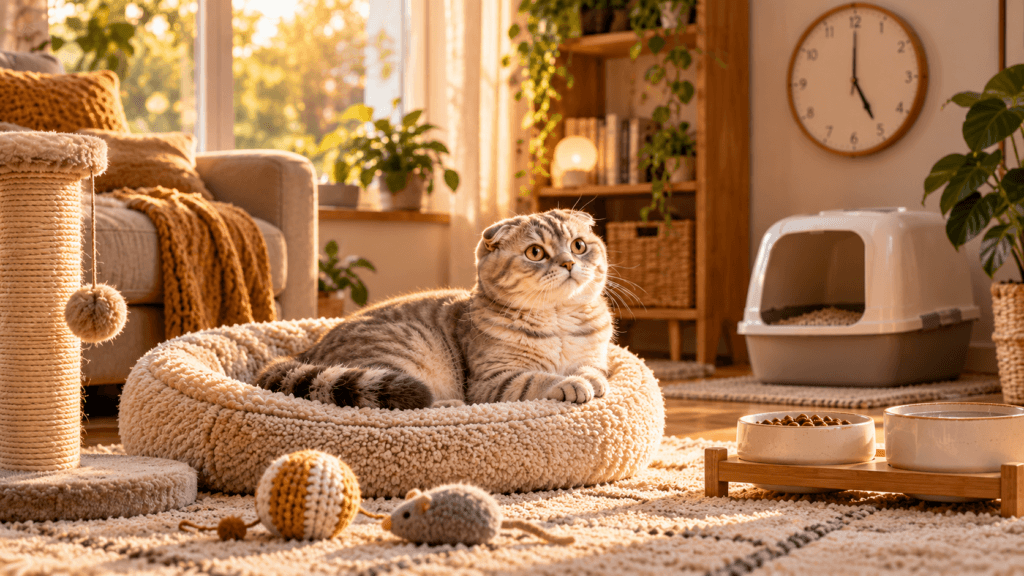
A cat that has everything it needs is more likely to settle comfortably.
Before leaving, make sure there is fresh water, appropriate food, and a clean litter tray. Remove medicines, cleaning products, toxic plants, loose wires, dangerous foods, and toys with strings that could cause trouble while nobody is watching.
Cats Protection recommends safe toys, puzzle feeding, hiding areas, and raised resting places as useful forms of enrichment when cats are home alone.
Your Scottish Fold does not need a room packed with twenty new toys every morning. A few safe things your cat actually uses are more valuable.
A favorite window spot, scratching post, cardboard box, puzzle feeder, comfortable bed, and a couple of safe solo toys may be enough for a cat that spends much of the workday resting.
How to Help a Scottish Fold Get Used to Being Alone
If your cat struggles when you leave, start small.
Go into another room or leave the home briefly. Return before the situation becomes overwhelming. Gradually increase the time if your cat remains calm.
Keep feeding and play at fairly predictable times. Give your cat opportunities to entertain themselves rather than providing constant attention every minute you are home.
PDSA advises against punishing cats for behavior linked with anxiety. Punishment can make stress worse. It recommends calm practice, predictable routines, hiding options, toys, and puzzle activities instead.
If your cat continues to show significant distress despite gradual practice, talk to your vet. A veterinary check can help rule out physical causes before a qualified behavior professional becomes involved.
Does a Scottish Fold Need Another Cat for Company?
Not necessarily.
Scottish Folds can live with other pets, and TICA notes that the breed can get along well with other family animals when introductions are handled properly.
That does not mean buying a second cat is the correct solution every time a Fold spends the day alone.
Blue Cross explains that cats have very individual social needs. Some form close relationships with other cats, while many are perfectly comfortable as the only cat in the home. Bringing a new cat into the household can also create stress if the cats are not compatible.
If you already have a bonded pair, their companionship may be valuable.
If you have one happy adult Scottish Fold, do not assume you must adopt another cat just because you work outside the home.
Look at the cat you already have first.
What Scottish Fold Owners Say About Leaving Them Alone
Owner experiences show why one rule does not fit every Scottish Fold.
In the Scottish Fold owner discussion provided for this article, one commenter described the breed as very social and felt long periods alone were not ideal. Another said Folds prefer having their people around but believed a cat could manage while the owner worked if they spent quality time together when home. A third summed the issue up simply: every cat is different. Scottish fold and Scottish stra…
A Scottish Fold Reddit discussion shows the same mixed picture. The original question came from an owner worried about leaving a four month old Fold alone for eight hours. Some owners reported adult Folds coping with normal workdays and spending much of that time sleeping. Others described cats with stronger separation issues or said companionship helped in their household.
These stories are useful because they reflect real homes, but they are not veterinary research.
What they do reinforce is something the better scientific and veterinary guidance also points toward: age, health, environment, and individual personality matter.
When Should Someone Check on Your Scottish Fold?
Arrange more frequent care when your Scottish Fold is a young kitten, has a medical condition, needs medication, has mobility problems, has recently been ill or had surgery, or has already shown difficulty coping alone.
You should also arrange care when your absence will extend beyond a normal day.
A reliable sitter is not only there to refill a bowl. They can notice whether your cat is walking normally, eating, drinking, using the litter box, and behaving like themselves.
That human check becomes more important the longer you are away.
When Should You Speak to a Veterinarian?
Speak to your veterinarian if your Scottish Fold suddenly changes behavior or repeatedly appears distressed when left alone.
Loss of appetite, litter box changes, unusual vocalization, hiding, aggression, reduced activity, reluctance to jump, changes in grooming, or obvious discomfort can have behavioral causes, medical causes, or both.
If your cat has always handled your workday well and suddenly stops doing so, do not immediately assume they have become lonely.
A change from that cat’s normal behavior is the important part.
So, Can Scottish Folds Be Left Alone?
Yes. Many healthy adult Scottish Folds can spend a normal part of the day alone, and an 8 hour workday may be manageable for an adult cat that is healthy, settled, and comfortable with the routine.
However, Scottish Folds are generally affectionate, family focused cats, so regular interaction still matters. Kittens need much more frequent care, while seniors and cats with health or mobility problems may also need shorter periods alone.
There is no scientifically established Scottish Fold specific maximum number of hours.
Watch your own cat. If they eat, play, use the litter box normally, settle comfortably, and behave like themselves when you return, that tells you more than an arbitrary online time limit.
If their behavior changes, investigate why.
Question we collect from Scottish Owners
Can Scottish Folds be left alone all day?
A healthy adult Scottish Fold may manage a normal workday alone, but regularly leaving a cat for very long periods is not ideal. General veterinary guidance suggests around 8 to 12 hours for many healthy adult cats, depending on the individual cat and home situation.
Can I leave my Scottish Fold alone for 8 hours?
For many healthy adults, yes. Make sure your cat has food, fresh water, a clean litter box, a safe environment, and suitable enrichment. Kittens and cats with medical needs require more frequent attention.
Do Scottish Folds get lonely?
Some may. Scottish Folds tend to be loyal and involved with their families, but individual cats vary. There is no strong evidence showing that Scottish Folds have a proven higher rate of separation anxiety than other cats.
Do Scottish Folds have separation anxiety?
Cats can experience separation related problems, but a Scottish Fold showing unusual behavior should not automatically be diagnosed with separation anxiety. Medical causes should also be considered, especially when behavior changes suddenly.
Can Scottish Fold kittens be left alone?
Yes, but for shorter periods than adults. Young kittens require more frequent feeding, supervision, and interaction. Healthy weaned kittens generally should not be expected to stay alone for a full adult workday.
Can a Scottish Fold be left alone overnight?
A healthy adult may cope with an occasional overnight absence if properly prepared, but longer trips require human care. If you will be away for more than 24 hours, arrange for a trusted person to check your cat.
Do Scottish Folds need another cat?
No. Some Scottish Folds enjoy living with another compatible cat or pet, while others are comfortable as the only cat. Adding another cat should be based on personality and compatibility, not treated as an automatic fix for loneliness.
Are Scottish Folds clingy?
Some can be very attached to their people. TICA describes them as loyal cats that may follow family members from room to room. That does not mean every Scottish Fold is clingy or unable to spend time alone.
Sources and References
- The International Cat Association was used for Scottish Fold temperament and breed behavior information.
- PetMD veterinary guidance by Hannah Hart, DVM, was used for general adult cat and kitten alone time guidance.
- Cats Protection was used for home safety, kitten care, enrichment, litter, and environmental preparation guidance.
- The PLOS One study on separation related problems in domestic cats was used for research on possible separation related behaviors.
- PDSA veterinary guidance was used for signs of stress, behavior changes, routine, and the importance of ruling out medical causes.
- Blue Cross guidance was used for information about individual feline social needs and living with other cats.
- Peer reviewed Scottish Fold research indexed by PubMed was used for information about osteochondrodysplasia and mobility related signs.







2 Responses