



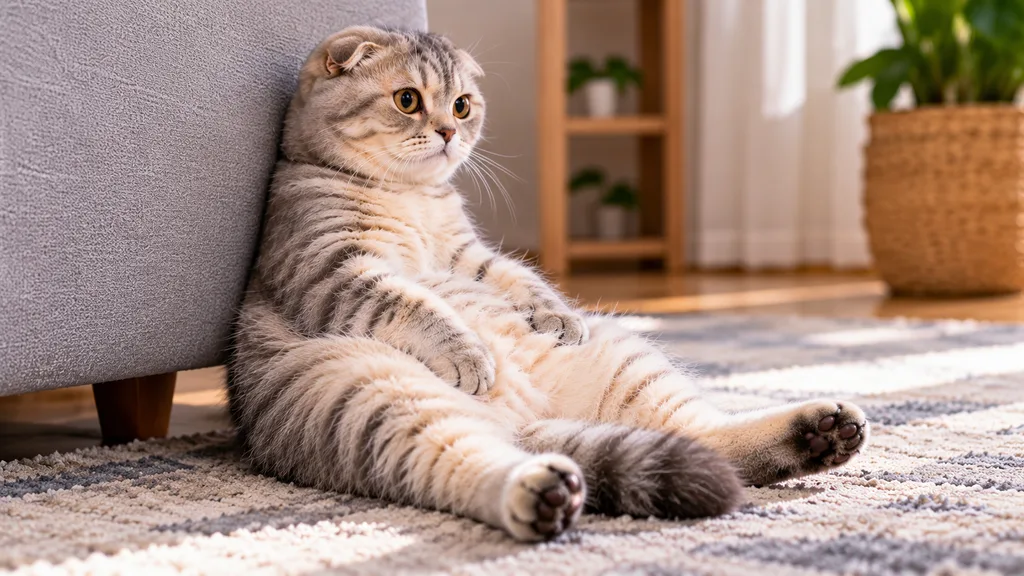
Scottish Fold sitting can look strangely human. A Fold may lean backward, stretch both hind legs in front of the body, and rest its front paws near the belly as if it has settled into a chair. This relaxed position is commonly called the Buddha pose or Buddha sit.
For many Scottish Folds, this may simply be a comfortable way to rest. Human like sitting is well known in the breed, and some cats use the position regularly without showing any obvious problem. However, Scottish Folds also carry a genetic change that affects cartilage and bone development, so their sitting position deserves a little more attention when it appears together with stiffness, reduced jumping, or other changes in normal movement. The pose alone does not prove that a cat is in pain.
If you are still learning what is normal for this breed, our Scottish Fold cats guide covers their personality, appearance, health, care, and everyday behavior in more detail.
What Is the Scottish Fold Buddha Pose?
The Buddha pose describes a Scottish Fold sitting back on its bottom while the hind legs stretch forward or slightly apart. The front paws usually rest naturally against the body or between the legs. Because the back is more upright than it would be in a typical cat sitting position, the pose can look surprisingly similar to the way a person sits on the floor.
This posture has become strongly associated with Scottish Cats. Breed references describe Folds sitting upright like humans and note that people familiar with the breed often call it the Buddha sit. Some Scottish Folds also briefly rise upright on their hindquarters when something catches their attention, but that alert position is different from the more relaxed Buddha pose.
A Scottish Fold sitting this way may stay in the position for a few seconds or settle there for much longer. What matters most is not how funny or unusual the pose looks to us, but whether the cat appears relaxed and moves normally before and after sitting down.
Why Do Scottish Folds Sit Like Humans?
There is no single proven reason why every Scottish Fold sits like a human. Some cats probably use the position because it simply feels comfortable. Cats often develop personal resting habits, and one Fold may regularly use the Buddha pose while another cat of the same breed may rarely sit that way.
The breed’s physical structure is still relevant. The genetic change responsible for folded ears affects cartilage, and research has linked the folded ear trait with a variant in the TRPV4 gene associated with Scottish Fold osteochondrodysplasia. This condition can affect bones and joints in other parts of the body, not only the ears.
This helps explain why Scottish Fold posture should be considered in context. A cat with stiffness or discomfort may change the way it sits, lies down, gets up, or jumps because some positions feel easier than others. Veterinary pain guidance also recognizes changes in sitting, standing, lying down, jumping, and movement as possible clues to discomfort.
It is still too strong to say that every Fold uses the Buddha pose specifically to relieve painful joints. The position itself has not been shown to be a reliable pain test. A comfortable cat may sit like this simply because it likes the position, while a cat with joint discomfort may also alter its posture to stay comfortable. Both possibilities need to be kept in mind.
Why Do Scottish Folds Sit in Weird Positions?
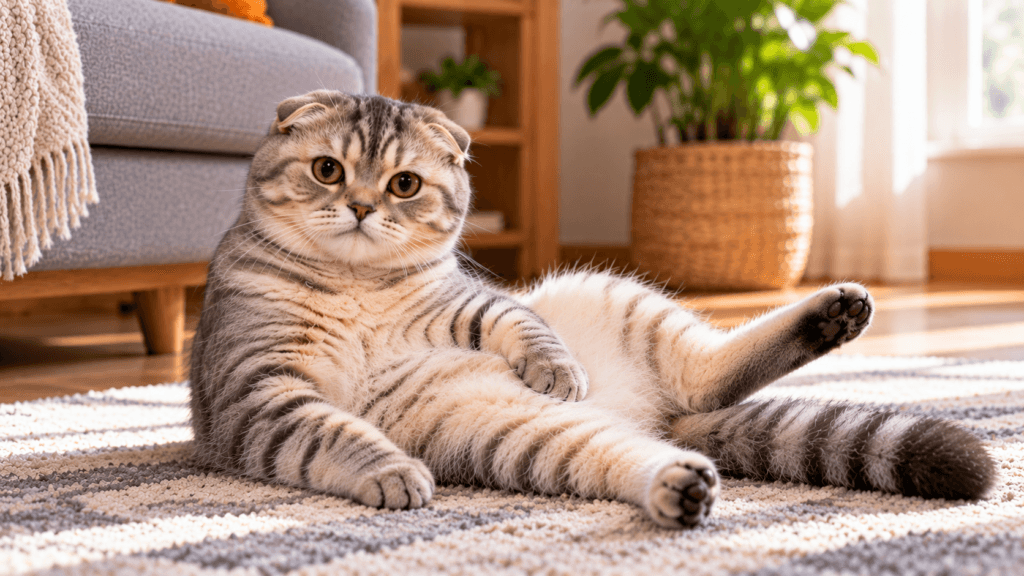
The Buddha pose is not the only Scottish Fold sitting position that can look unusual. Some Folds stretch both hind legs straight in front of them, sit with their legs slightly apart, lean their back against furniture, or briefly sit almost upright when watching something.
These positions can look odd because they are different from the compact sitting posture people usually expect from cats. The appearance of the posture, however, tells only part of the story.
A better way to judge the situation is to compare the position with the cat’s normal routine. Imagine a Scottish Fold that has used the same strange sitting position since it was young. The cat still jumps onto the sofa, runs to its food, plays normally, climbs without hesitation, and gets up smoothly after resting. In that situation, the unusual Scottish Fold posture is much less concerning on its own.
Now compare that with a cat that has only recently begun sitting differently. The same cat also pauses before jumping onto the bed, spends more time sleeping on the floor, and looks stiff when it first stands up. The sitting position may look similar, but the surrounding changes make the second situation more important.
This is why a single photo rarely tells you enough. Changes in movement over days or weeks are usually more useful than the appearance of one pose.
Is Scottish Fold Sitting Like This Normal?
Scottish Fold sitting in the Buddha position can be normal for an individual cat. If your Fold chooses the position voluntarily, gets up easily afterward, walks normally, still plays, and continues making its usual jumps, there may be no reason to interfere with the way it prefers to sit.
You do not need to keep repositioning a comfortable cat simply because the pose looks unusual. Instead, learn what normal movement looks like for your own Scottish Fold. Notice how easily the cat stands after sleeping, how it walks across the room, whether it uses stairs, and whether it still jumps onto the furniture it normally uses.
The most useful clue is often a change from that normal pattern. Chronic pain in cats can develop gradually, and owners are often the people best placed to notice small differences in jumping, running, climbing, play, grooming, and other everyday behaviors.
That makes a familiar Buddha pose very different from a new Scottish Fold sitting position that appears at the same time as reduced mobility.
Does the Buddha Pose Mean a Scottish Fold Is in Pain?
The Buddha pose alone does not mean a Scottish Fold is in pain.
Scottish Fold osteochondrodysplasia can cause pain, stiffness, and mobility problems, but those problems cannot be diagnosed by looking at one sitting position. The severity of skeletal changes can also vary between individual cats.
What makes Scottish Fold sitting more important is the presence of other signs. Cats with chronic musculoskeletal discomfort may stop jumping as high as before, move more slowly, avoid stairs, sleep in easier to reach places, or change the way they sit and lie down. Cats also tend to hide pain, which is why behavioral changes at home are so useful when assessing chronic discomfort.
A Fold that still runs, plays, climbs, grooms, and gets up comfortably gives you a very different picture from one that has become less active and stiff. The Buddha pose should therefore be treated as one observation rather than a diagnosis.
Signs to Watch Along With a Strange Sitting Position
Scottish Fold pain can be subtle, especially when changes develop slowly. A new posture becomes more meaningful when it appears together with other mobility or behavior changes.
Watch for these changes:
- hesitation before jumping or jumping lower than before
- stiffness when standing up or walking
- limping or an unusual gait
- less interest in running or playing
- difficulty using stairs or climbing
- a thick, stiff, or less flexible tail
- reduced grooming or difficulty reaching parts of the body
- irritation when the hips, legs, back, or tail are touched
- choosing lower or easier to reach sleeping places
- difficulty getting into or out of the litter box
- frequently changing position as if unable to settle comfortably
Veterinary pain guidance places particular importance on changes in normal activities such as running, jumping, using stairs, grooming, and resting because chronic pain in cats is often expressed through behavior rather than obvious crying or dramatic limping.
If your cat has stopped making jumps that used to be easy, this is a good place to link naturally to the future article Scottish Fold Won’t Jump Anymore.
This section can also link to Scottish Fold Signs of Pain once that article is published.
Why the Scottish Fold Gene Matters
Understanding the folded ear gene helps make sense of why mobility receives so much attention in this breed.
The folded ears are caused by altered cartilage development. The same inherited change is associated with osteochondrodysplasia, which can affect bones and joints elsewhere in the body. This connection is why the Scottish Fold posture should not be discussed only as a cute breed behavior.
The visible ear fold is simply the feature people notice first. Changes related to the condition can also involve the limbs, joints, and tail, and some affected cats develop stiffness or difficulty moving.
The severity is not identical in every cat. One Scottish Fold may show obvious mobility changes while another appears much more comfortable. That variation is another reason why statements such as “the Buddha pose always means pain” are too simple.
A more useful approach is to know your cat’s normal movement and watch for changes over time.
How to Check Your Scottish Fold at Home
You do not need to bend your cat’s joints, pull on the tail, or force the legs into different positions to check whether something is wrong. In fact, doing that to a painful cat could make the experience worse.
Normal daily behavior gives you much better information.
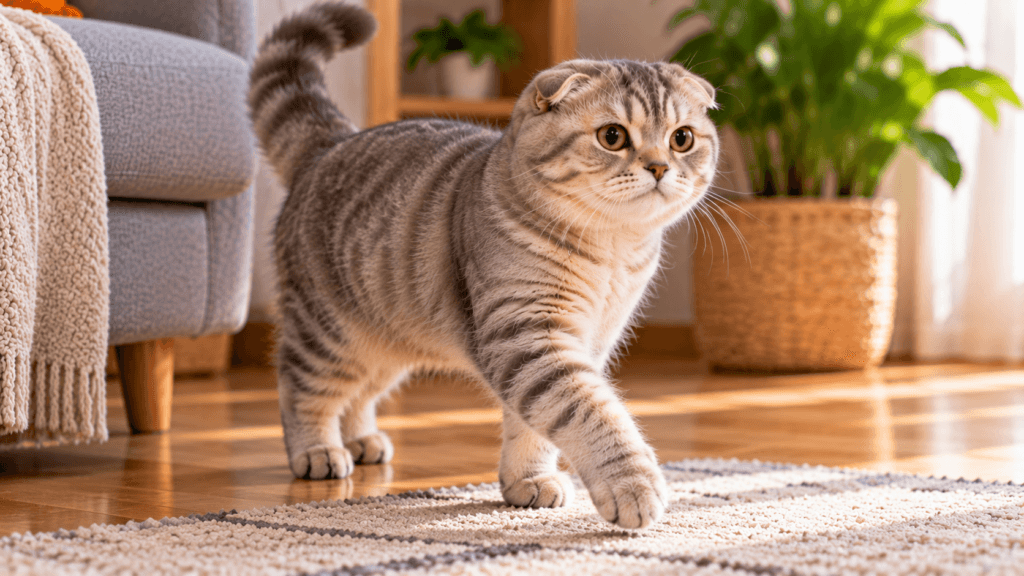
Watch how your Scottish Fold gets up after a long sleep. Notice whether it walks smoothly across the room and whether it still uses its normal routes around the house. Pay attention to the jumps your cat chooses to make naturally rather than repeatedly encouraging it to jump as a test.
Older videos can also be surprisingly useful. If you have clips from a few months earlier, compare the way your cat walks, jumps, or climbs with what you see now. Gradual changes are easy to miss when you watch the same cat every day.
If something looks different, record a short video for your veterinarian. Owner observations and videos can be particularly valuable because cats may behave very differently in a clinic than they do at home.
When Should You Contact a Vet?
A familiar Scottish Fold sitting position in a comfortable and active cat is very different from a new posture appearing alongside stiffness or reduced movement.
Arrange a veterinary check if your cat begins sitting differently and you also notice less jumping, an unusual walk, stiffness after rest, reduced play, difficulty grooming, sensitivity to touch, or changes in tail movement. You do not need to wait until the cat cries or develops an obvious limp, because chronic pain in cats is often much less dramatic.
Sudden severe pain, inability to walk normally, marked weakness, or a rapid loss of mobility needs quicker veterinary attention.
Avoid giving your cat human pain medicine unless a veterinarian has specifically prescribed an appropriate treatment. Pain control in cats needs to be chosen carefully because medicines that are safe for people may not be safe for cats.
Making the Home Easier for a Stiff Scottish Fold
If your veterinarian identifies mobility problems, a few practical changes can make everyday life easier.
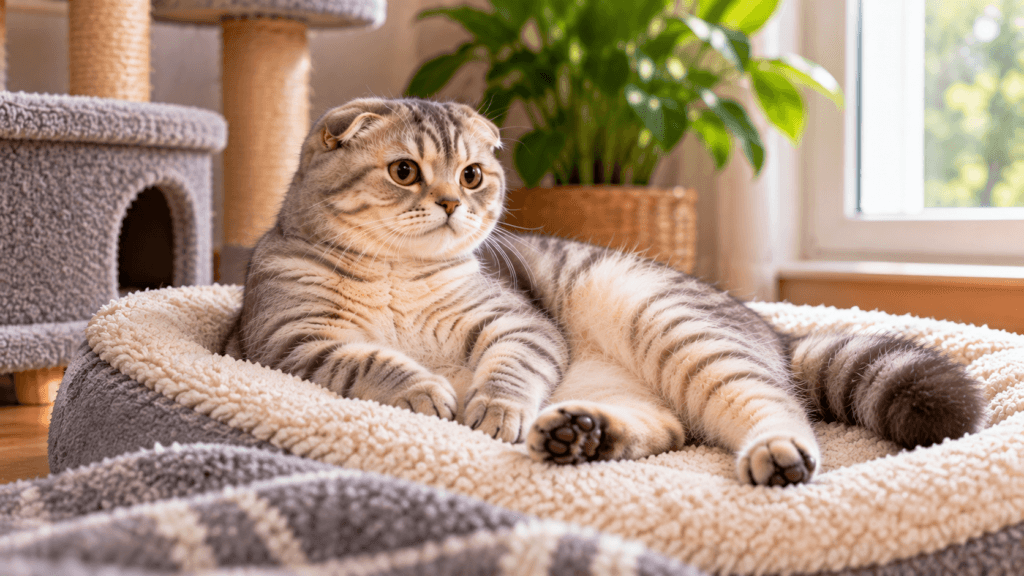
A low, supportive bed may be more convenient than a sleeping place that requires a large jump. Stable pet steps can make it easier to reach a sofa or bed. A litter box with a lower entrance may help a cat that finds stepping over a high side uncomfortable.
Smooth floors can also be difficult for a cat that feels stiff or unstable. A secure rug can provide better footing in areas the cat uses frequently.
Food, water, litter, and favorite resting areas should be easy to reach without repeated climbing or jumping. These changes do not treat the underlying condition, but they can reduce unnecessary physical effort.
Maintaining an appropriate body condition is useful as well, because extra body weight increases the load carried by the joints.
Frequently Asked Questions
Why does my Scottish Fold sit like a person?
Many Scottish Folds use a relaxed human like sitting position known as the Buddha pose. It may simply be comfortable for the individual cat. The position becomes more important if it is new or appears together with stiffness, reduced jumping, or other movement changes.
What is the Buddha pose in Scottish Fold cats?
The Buddha pose is a sitting position where the cat rests back on its bottom with the hind legs stretched forward or outward. The front paws usually rest near the belly or between the legs.
Why does my Scottish Fold sit with its legs out?
Some Scottish Folds naturally prefer sitting with their hind legs extended. The posture by itself does not prove joint pain. If it appears alongside stiffness or reduced mobility, however, a veterinary check is sensible.
Do all Scottish Folds sit like humans?
No. Human like sitting is well known in the breed, but individual Scottish Folds have different resting habits. Some use the Buddha pose frequently, while others may rarely or never sit this way.
Why is my Scottish Fold suddenly sitting strangely?
A sudden change in posture deserves more attention than a position your cat has always used. Look for other changes such as reduced jumping, stiffness, less play, difficulty grooming, or an unusual walk.
Does the Buddha pose mean my Scottish Fold has arthritis?
No. A sitting position alone cannot diagnose arthritis or Scottish Fold osteochondrodysplasia. A veterinarian needs to consider the cat’s history, behavior, physical examination, and sometimes additional testing or imaging.
Final Thoughts
Scottish Fold sitting can look funny, relaxed, and surprisingly human, especially when a cat settles into the classic Buddha pose. For many Folds, this may simply be one of their preferred ways to rest.
The position should not automatically be treated as evidence of pain. At the same time, Scottish Folds have a genetic cartilage and bone condition that makes changes in mobility worth watching throughout life.
The most useful thing an owner can do is learn what is normal for the individual cat. If your Fold sits like a person but still gets up easily, walks normally, plays, grooms, and makes its usual jumps, the posture alone tells you very little about discomfort.
If Scottish Fold sitting suddenly changes and that change appears alongside stiffness, reduced jumping, a stiff tail, less activity, or another mobility problem, that is when a veterinary check becomes much more useful.
Sources Used for Research
The article was researched using breed information from The International Cat Association, peer reviewed research on the TRPV4 variant associated with Scottish Fold osteochondrodysplasia, and feline pain assessment guidance from the American Animal Hospital Association.








2 Responses