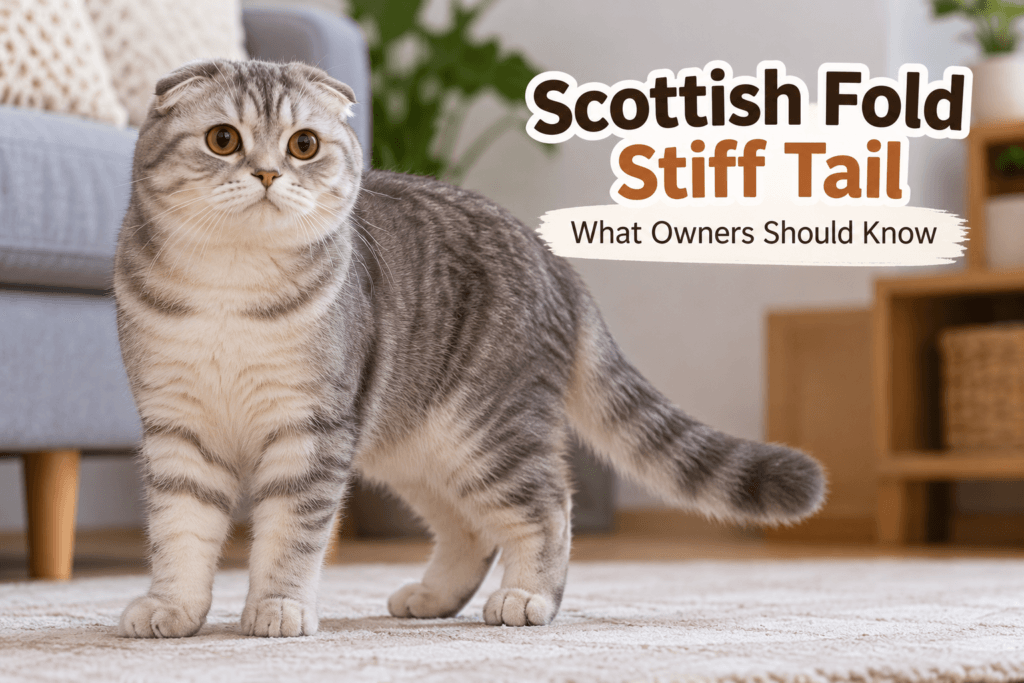


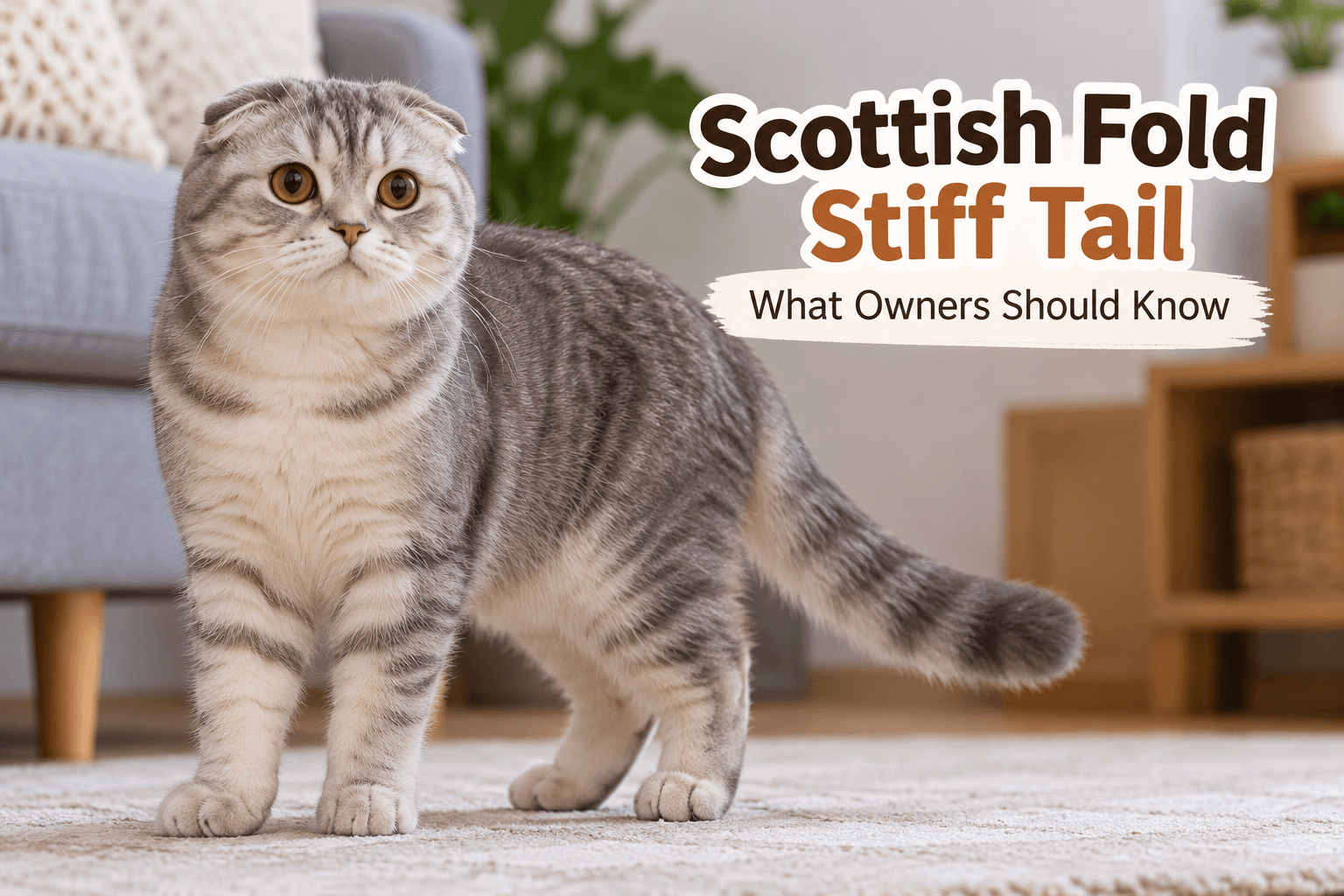
A Scottish Fold stiff tail may look shorter, thicker, straighter, or less mobile than a cat owner expects. You might notice that the tail barely curves when your cat walks, or that it looks different from tails in other cat photos. Because Scottish Folds have a particular genetic background, those observations deserve a careful explanation, not an immediate diagnosis.
A Scottish Fold tail can also appear still for an ordinary reason: the cat is resting, watching something, or holding a temporary position. Shape, posture, and actual movement are three different things. This guide explains how to tell those observations apart, what reliable breed information says, and what to discuss with a veterinarian if something changes.
What Does a Stiff Scottish Fold Tail Look Like?
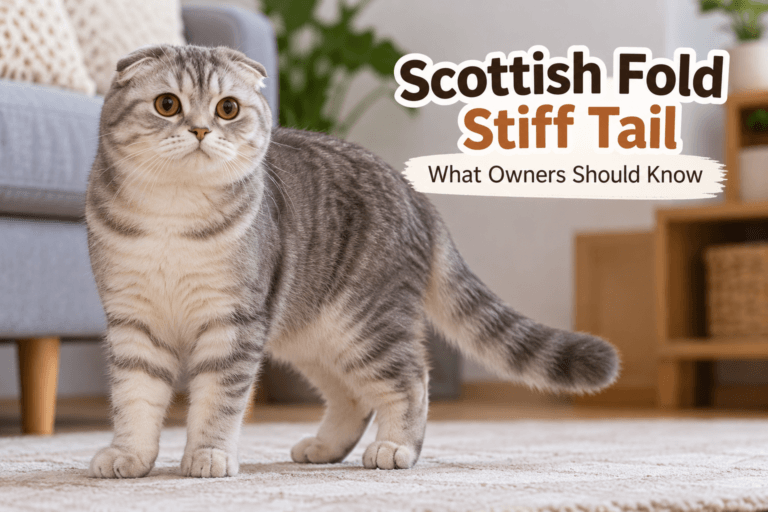
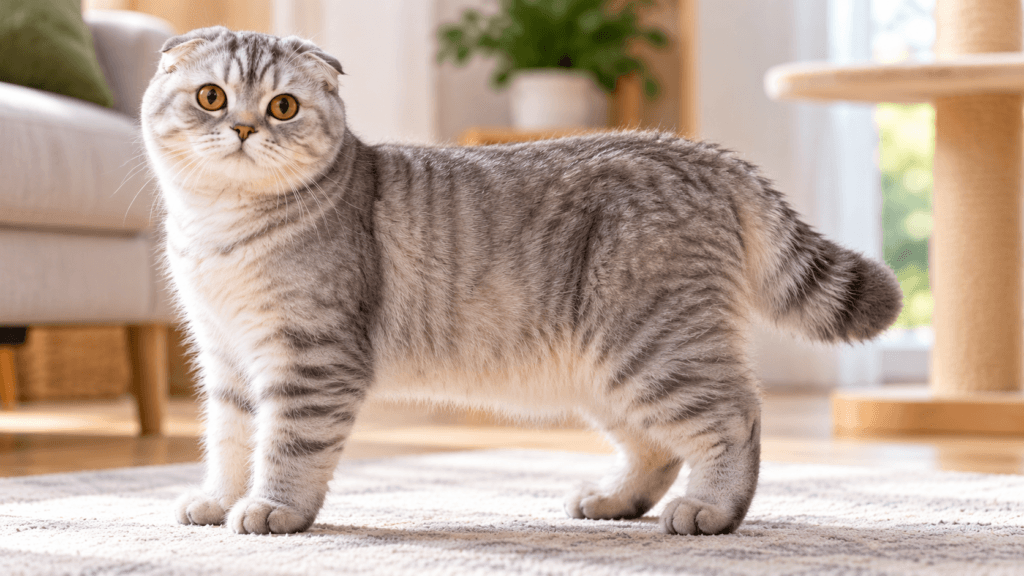
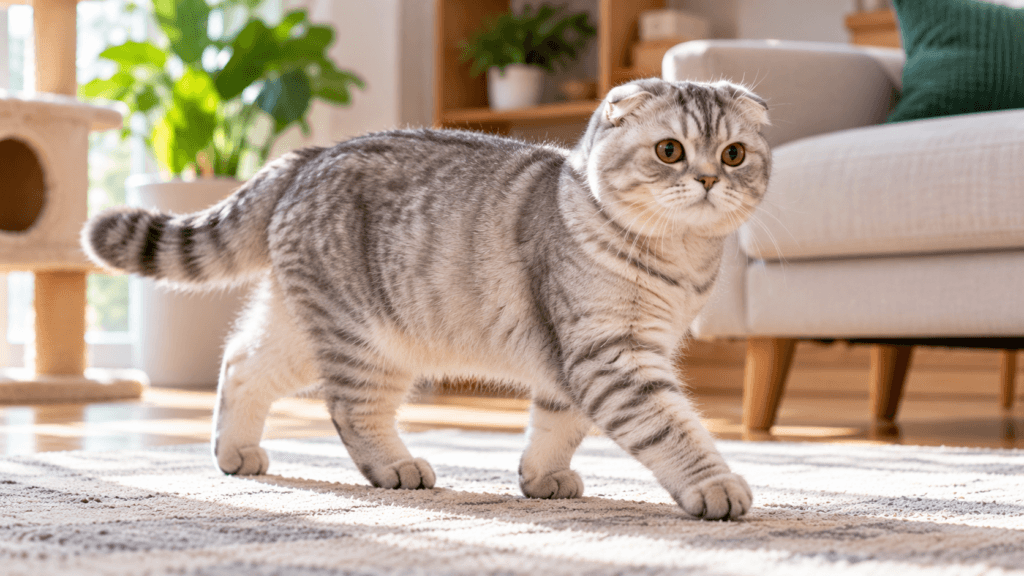
When owners say a Scottish Fold tail is stiff, they may be describing its appearance rather than a proven loss of flexibility. Some tails look relatively short and broad. Others look straight in many photographs or seem to make only small movements during a walk. A fluffy coat can make the shape even harder to judge from a distance.
The same tail can appear quite different depending on the cat’s position. If your cat is lying against a cushion, part of the tail may be hidden. If it is standing with the tail lowered, a photograph may make the tail look unusually straight. None of these single moments establishes what is happening inside the tail.
Shape, position, and movement are different
| What you notice | What it actually tells you | What it does not tell you |
|---|---|---|
| Short-looking tail | The visible length seems relatively short | Whether the tail is stiff |
| Thick-looking tail | The outline appears wide or heavy | Why it has that shape |
| Tail held straight | The cat is using a particular position | Whether movement is restricted |
| Little movement during walking | The tail appears less expressive in that moment | The underlying explanation |
| A recent change | Today’s behavior differs from what you remember | Whether a particular condition is responsible |
It is more useful to notice a pattern across ordinary activities than to judge one photograph. A Scottish Fold tail that stays in almost exactly the same position during several familiar activities raises a different question from a tail that is simply still during a nap.
Is a Scottish Fold Tail Supposed to Be Flexible?
A Scottish Fold tail is not automatically meant to be rigid because the cat has folded ears. The breed is often discussed in connection with tail flexibility, but that does not make stiffness a harmless feature to assume in every individual.
A cat may lift its tail when greeting someone, lower it as it enters a room, or leave it almost motionless while concentrating on a toy. The important point is not how often the tail moves every minute. It is whether the tail’s usual range of visible movement seems to have changed.
If your cat has always carried its tail low, comparing it with an energetic kitten may not be helpful. Instead, compare your Scottish Fold with its own normal routine. The way a Scottish Fold tail looks while a cat rests may be very different from how it looks when the same cat walks toward a food bowl.
Persistent stiffness and an ordinary straight position should not be treated as interchangeable descriptions. If you are unsure which you are noticing, describe the behavior rather than trying to test flexibility yourself.
Why Scottish Fold Tail Stiffness Is Discussed With Breed Genetics
The folded ears that give Scottish Folds their name are associated with a variant in a gene called TRPV4. This genetic background is important because cartilage contributes to the structure of ears and parts of the skeleton.
According to the UC Davis Veterinary Genetics Laboratory, the variant linked to folded ears is also associated with cartilage- and bone-related differences, including thickened and inflexible tails. The laboratory notes that the timing and extent of related changes can vary among cats.
You may encounter the term Scottish Fold osteochondrodysplasia when researching a Scottish Fold tail. It names a genetic condition studied in the breed; it is not a label owners can apply to an individual cat simply because a tail looks thick or straight.
The genetic connection helps explain why stiff tails appear in discussions of Scottish Fold health. It does not mean a particular tail photograph can reveal a cat’s condition, degree of discomfort, or future health. Those are individual questions that require professional assessment.
Why one cat may look different from another
Coat length, body size, age, and natural tail position can make comparisons misleading. A longhaired Scottish Fold may appear to have a thick tail because of its coat. Another cat may have a noticeably different tail outline even when photographed in the same position.
Research also describes variation in how breed-associated skeletal changes appear. For readers, the practical takeaway is limited but useful: the shape of a Scottish Fold tail matters as an observation, yet it does not independently explain why that shape is present.
Short, Thick, Straight, or Stiff: Understanding the Words
People frequently use these descriptions as though they mean the same thing. They do not. Short describes length. Thick describes outline or width. Straight describes position or shape. Stiff is usually a concern about flexibility or movement.
For example, a Scottish Fold tail can be short-looking without the owner noticing any unusual movement. A straight-looking tail in a resting photograph may also change position naturally when the cat gets up. Conversely, someone may notice a change in movement without seeing a major difference in the tail’s outline.
Clear language makes it easier to discuss what you have actually observed. Instead of saying, “My cat’s tail has a disease,” you might say, “Its tail looks straighter than it did last month,” or “It doesn’t lift its tail during greetings as often as it used to.” Such descriptions are specific without guessing at a cause.
Scottish Fold Tail Movement During Everyday Activities
A cat’s movements make more sense when considered together. Tail position can change as the cat walks, watches birds through a window, moves toward you, or settles down on a bed. There is no single tail position that should be expected at every moment.
If you are concerned about Scottish Fold tail movement, watch normal activities that happen anyway. Is your cat using the same favorite resting spots? Does it still approach familiar people and toys? Have you noticed a change in climbing, grooming, or walking? These observations give more context than a tail photograph alone.
Walking, greetings, and play
A cat may hold its tail up during a greeting, lower it while exploring, or move the tip when focused on a toy. Some cats are more expressive than others. A Scottish Fold tail that stays still while the cat watches a toy does not, by itself, establish an issue.
A change from your own cat’s usual movement is more informative. You might notice that the tail stays low through several activities or that the cat no longer chooses a familiar jumping spot. These changes cannot identify a cause, but they are useful details to remember.
Resting and unusual positions
Scottish Folds are often photographed sitting upright or stretching their hind legs forward. These poses can draw attention away from what the rest of the body is doing. In our guide to why Scottish Folds sit like humans, we explain why one unusual position should not be treated as a complete picture of a cat’s wellbeing.
The same idea applies here. A Scottish Fold tail appearing still in one sleeping position tells you much less than observing the cat’s movement over several days.
Scottish Fold Tail Changes in Kittens and Adults
Owners sometimes notice differences in tail shape while a Scottish Fold is still very young. Others start asking questions after their cat has reached adulthood. There is no single age or timeline that describes the visible experience of every cat.
A kitten’s changing body proportions can make its tail look different from one month to the next. Older photographs may be useful for observing growth, although photos cannot show the full range of movement. The appearance of a Scottish Fold tail in a kitten should not be compared too confidently with an adult cat’s tail.
What if a Scottish Fold kitten has a short, thick tail?
Describe what you can see: length, thickness, posture, and whether you have noticed any change. Avoid trying to make the kitten hold a different position or bending the tail to investigate it.
The same approach works for adult cats. If an adult Scottish Fold tail begins to look noticeably different or seems to move less during ordinary activities, record the observation and discuss it with a veterinarian. Age alone cannot explain the reason.
How to Observe a Scottish Fold Tail Without Testing It
You do not need to press, straighten, or twist a tail to understand how your cat normally carries it. Never force a Scottish Fold tail to bend in order to check whether it is stiff. Handling a sensitive area this way may be uncomfortable and cannot provide a reliable diagnosis at home.
Instead, watch your cat move voluntarily in familiar surroundings. The clearest moments may be walking down a hallway, approaching a regular meal, or leaving a favorite sleeping spot. If something seems different, a short video of ordinary movement can help you explain it later.
You can note when the change first caught your attention and whether it appears repeatedly or only in one setting. A simple record might include:
- When you first noticed the difference
- Whether the tail’s shape has always looked similar
- What the tail does during normal walking or greetings
- Any recent fall, accident, or other unusual event
- Whether your cat has changed familiar daily activities
You are not performing a physical examination. You are recording what you can see. If the Scottish Fold tail appears different in several ordinary situations, those details can help make a veterinary conversation clearer.
When a Change in Scottish Fold Tail Movement Matters
A long-standing tail position and a sudden new change are not the same question. Owners may want to discuss a tail that seems persistently less mobile, looks different from before, or appears alongside changes in the cat’s normal activity.
The information you provide does not have to include a suspected condition. It may be enough to say, “My cat used to lift its tail while walking toward me, and now I rarely see that,” or “The tail began looking different after a fall.”
If a Scottish Fold tail changes suddenly after an accident, or your cat appears distressed or has difficulty moving normally, seek prompt veterinary advice. An article cannot establish the cause or urgency for a particular cat from its appearance alone.
A veterinarian can consider the animal’s history, behavior, and other relevant information. The purpose of this guide is to help owners describe observations accurately, not to replace that assessment.
An Everyday Home Setup for Scottish Fold Cats
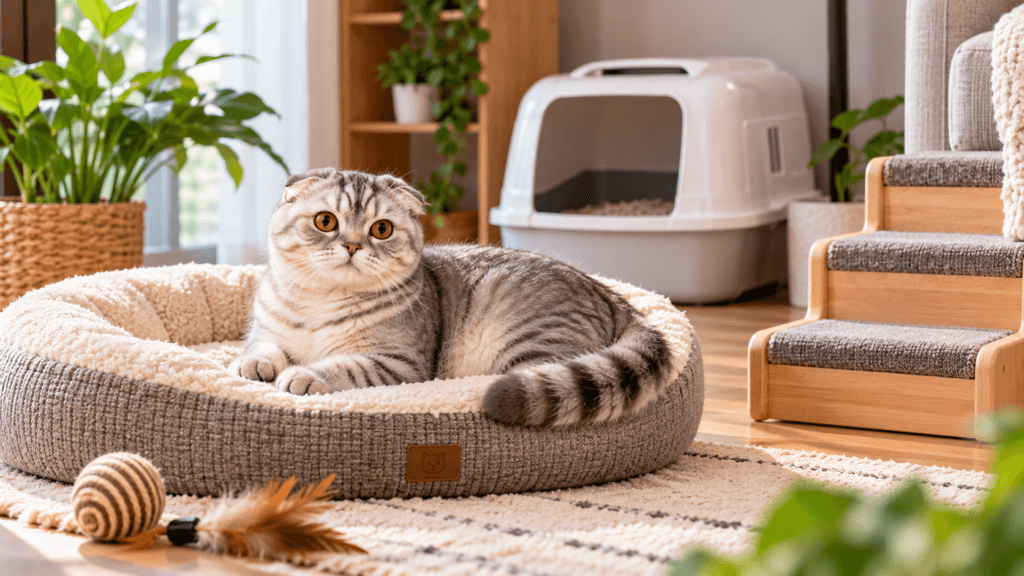
An accessible, comfortable home is useful for cats regardless of whether an owner has noticed anything unusual about the tail. Providing a choice of resting places, keeping pathways clear, and placing everyday essentials within easy reach are sensible parts of general cat care.
A floor-level bed gives a Scottish Fold another resting option if it does not want to climb. Stable pet steps may provide an alternative route to a familiar sofa, while a litter box with an easy entrance keeps an essential space approachable. These are environment and convenience ideas, not treatments for tail stiffness.
The position of food and water also forms part of a familiar routine. For other general cat-care topics beyond this breed-specific Scottish Fold tail guide, readers can explore PetsMastery. That site is a general reading resource here, not the evidence for any genetic or medical explanation in this article.
You can also explore our broader Scottish Fold Health and Care section for more breed-related everyday information. The best setup is one that suits the individual cat’s habits rather than a fixed checklist for every home.
Scottish Fold Tail Stiffness: Quick Guide
| Observation | Useful way to think about it |
|---|---|
| Tail looks short or thick | Its appearance alone cannot explain the cause |
| Tail stays straight in one photo | A single position cannot show flexibility |
| Tail is still during rest | Stillness may simply reflect what the cat is doing |
| Movement looks different over time | Compare with your own cat’s familiar routines |
| Kitten’s tail appears unusual | Development and individual differences require context |
| Sudden change after an accident | Seek prompt veterinary guidance |
The important difference is between noticing what a Scottish Fold tail looks like and assuming you already know what that appearance means. Observations are useful; guesses about an individual cat’s condition are not.
Frequently Asked Questions
Why is my Scottish Fold tail stiff?
The breed’s inherited folded-ear variant is associated with cartilage and skeletal changes, and veterinary sources describe thickened or inflexible tails among the possible findings. But a Scottish Fold tail that looks stiff cannot be explained from appearance alone. A veterinarian can assess concerns in the context of the individual cat.
Is a stiff tail normal for Scottish Fold cats?
Do not assume a persistently rigid Scottish Fold tail is simply a harmless breed trait. A tail held straight in one situation and a tail that consistently seems to move less are different observations. If the appearance or movement concerns you, professional advice is appropriate.
Can a Scottish Fold kitten have a stiff tail?
Differences in tail shape or movement may be noticed while a Scottish Fold is young. However, the appearance of a kitten’s Scottish Fold tail does not establish a specific explanation. Watching ordinary movement and discussing persistent concerns with a veterinarian is more useful than comparing photographs alone.
Why does my Scottish Fold have a short, thick tail?
Some cats have a visibly shorter or thicker tail outline. Breed-related skeletal differences are among the subjects described in veterinary genetics information, but coat, posture, and individual appearance also affect what owners see. Tail length or thickness alone cannot tell you the reason.
Can my Scottish Fold still play if its tail looks stiff?
A cat may continue eating, playing, walking, and interacting with family even when an owner notices an unusual tail shape. Daily activity by itself cannot confirm or exclude an underlying concern. Consider whether the cat’s familiar routines have changed rather than relying on one behavior.
Should I bend the tail to check its flexibility?
No. Do not pull, twist, press, or forcibly bend your cat’s tail. Watch how it moves during everyday activity instead. A veterinarian can assess a Scottish Fold tail that appears persistently stiff or has recently changed without relying on at-home manipulation.
Final Thoughts
A Scottish Fold tail may draw attention because it looks short, thick, straight, or unusually still. Those words describe different things, and one moment cannot provide the complete picture. The breed’s genetics help explain why tail flexibility is discussed, but they do not allow owners to identify a condition from a photograph.
Focus on your cat’s familiar routine and notice changes without forcing the tail to move. If a Scottish Fold tail seems persistently different, especially after an injury or alongside changes in normal activity, seek veterinary guidance. A calm, observation-based approach gives you better information than trying to diagnose your cat at home.