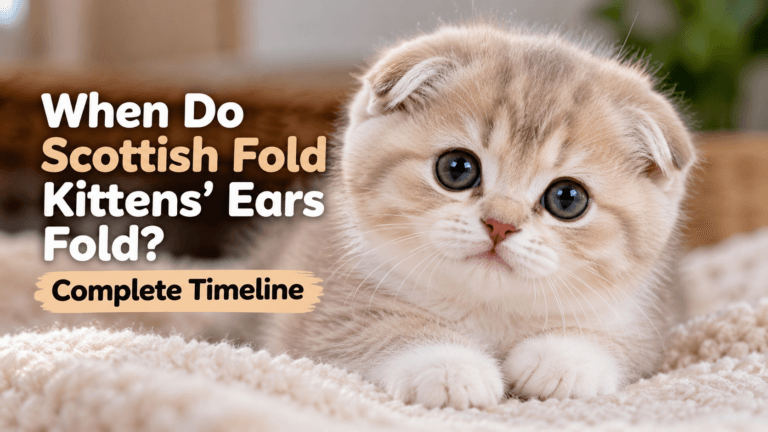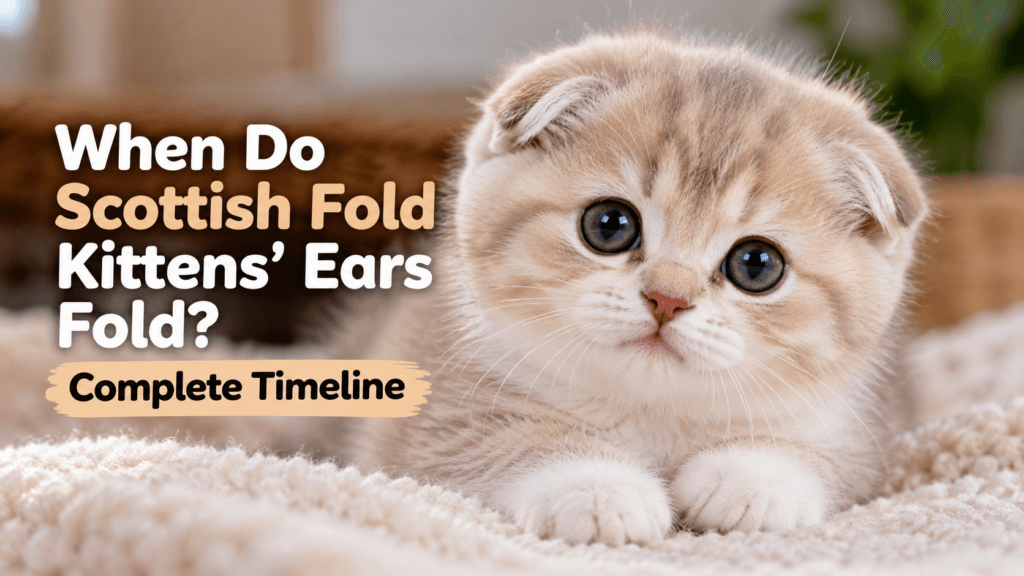


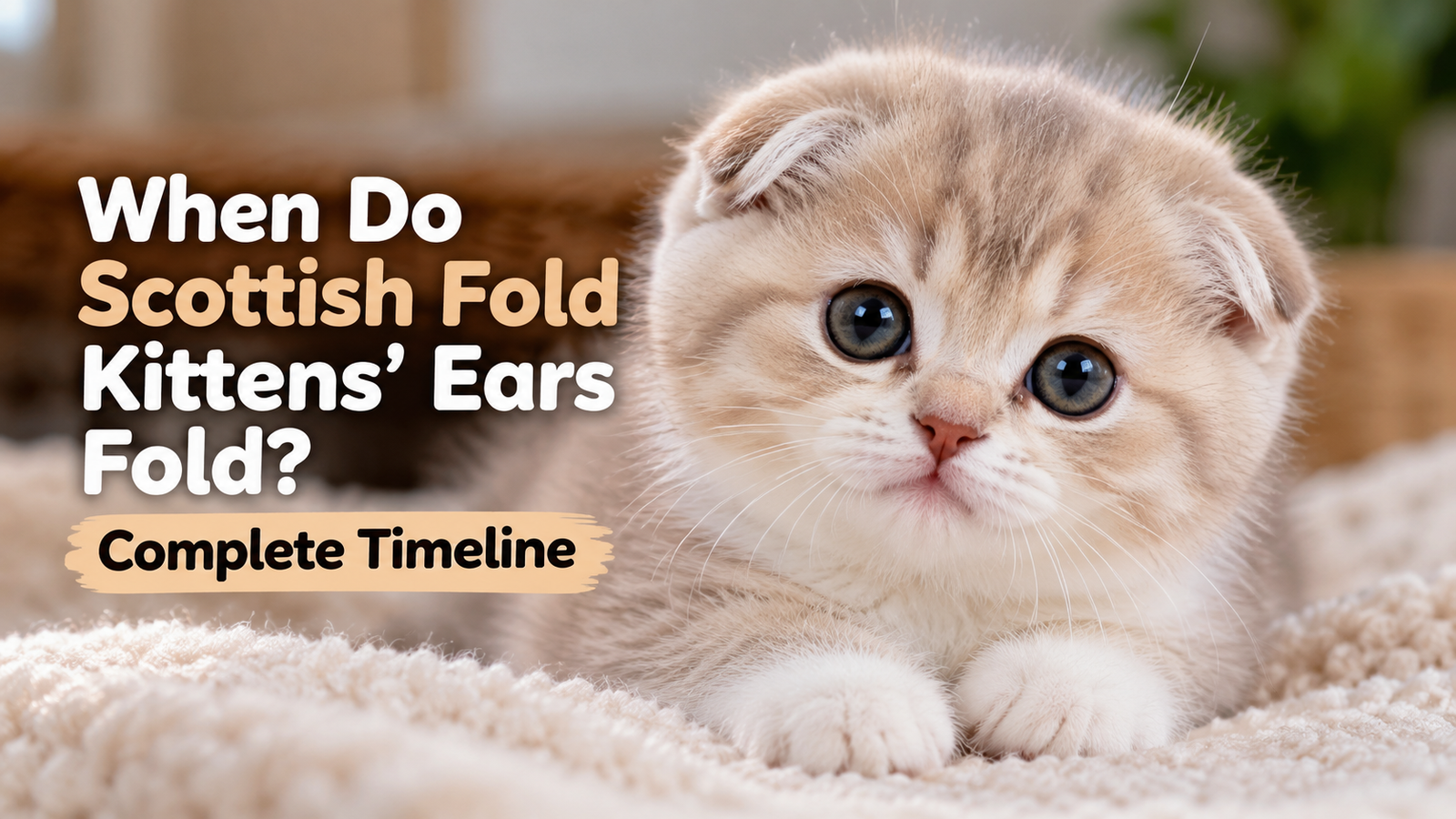
Scottish Fold kitten ears usually begin folding at around 3 to 4 weeks of age. All kittens in the Scottish Fold breed group are born without the characteristic forward fold. Kittens that inherit the folded-ear variant typically start showing a change around 18 to 24 days, while kittens without it keep upright ears. Those straight-eared kittens are commonly called Scottish Straights.
If your kitten is only two or three weeks old, its ears may not reveal much yet. Even at four weeks, a loose fold can be harder to notice than a tight one. The timeline below separates the changes owners can normally see from assumptions that a photograph cannot confirm.
Scottish Fold Kitten Ears: Week-by-Week Timeline
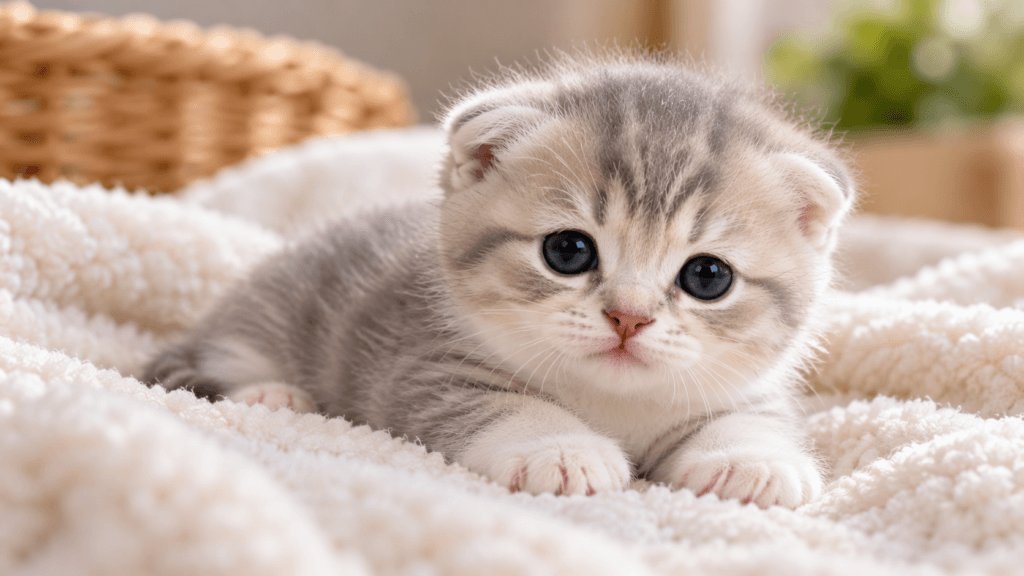
The most useful window for Scottish Fold kitten ears is the third and fourth weeks. Before then, Scottish Fold kitten ears and Scottish Straight kitten ears often look much alike. The later weeks are better for comparing their appearance, not for expecting a new fold to develop on a fixed date.
| Age | Typical appearance | What it means |
|---|---|---|
| Birth to week 1 | Small newborn ears, without the characteristic Scottish Fold crease | Fold status is not apparent at birth |
| Week 2 | Ears continue developing and becoming more upright | It is generally too early to judge the inherited fold by appearance |
| Week 3 | A subtle forward bend may appear | This is when folding can first become noticeable |
| Week 4 | A forward fold is often easier to recognize | Straight-eared littermates may still have upright ears |
| Weeks 5 to 6 | The existing fold is usually clearer | The depth and shape of the fold vary between kittens |
| Weeks 7 to 8 | Folded and straight-eared kittens are generally easier to distinguish | Not every folded ear lies tightly against the head |
| Weeks 9 to 12 | The kitten’s characteristic ear appearance is usually recognizable | Ear position can still look different as the cat grows |
This is a general guide, not a guarantee for each individual kitten. A birth date that is off by several days can also make online photo comparisons confusing.
Birth to 2 weeks: Ears have not developed the characteristic fold
Newborn kittens have small ears that sit close to the head. This natural newborn appearance is different from the forward fold associated with Scottish Fold genetics. During the first days, you cannot reliably sort a litter into folded and straight-eared kittens just by looking at the ears.
Scottish Fold kitten ears will change as the kitten grows, but there is no need to look for a dramatic fold during the first week. At two weeks, Scottish Fold kitten ears may still resemble those of a straight-eared sibling.
Week 3: The first forward bend may appear
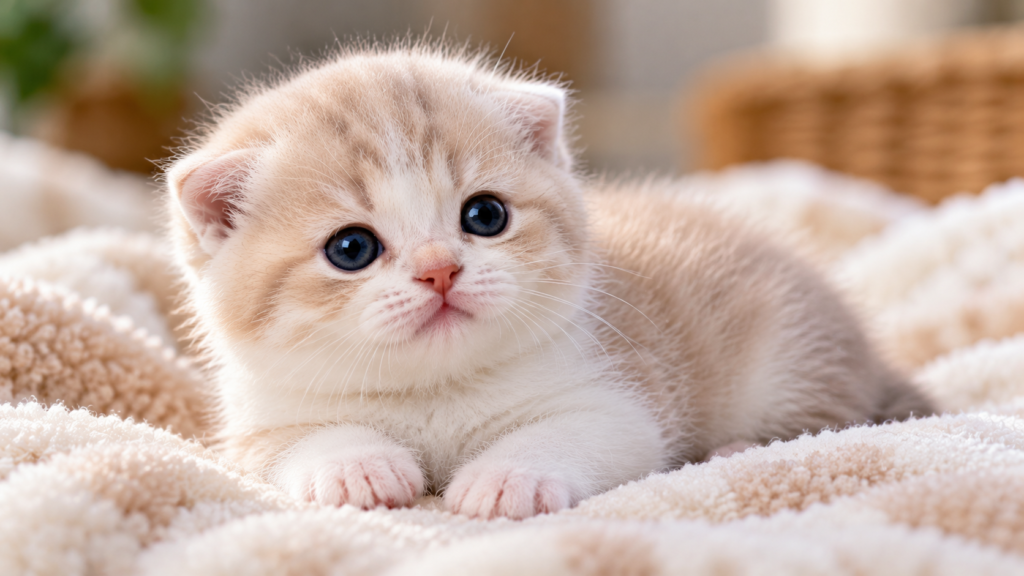
Around 18 to 24 days, some kittens begin showing a forward tilt near the ears. The change may be slight. In one kitten, the ear tips may visibly point down; in another, the bend may be difficult to spot without comparing photographs.
This is why pictures labeled “Scottish Fold ears at 3 weeks” can look so different. Scottish Fold kitten ears do not all reach the same visible appearance on the same day. Rather than expecting an overnight transformation, think of week three as the common beginning of the folding window.
Week 4: Folded ears become easier to recognize
By four weeks, kittens carrying the fold variant usually show a more recognizable forward ear shape. A kitten with a strong fold may have ears resting close to its rounded head, while another has a looser bend.
If Scottish Fold kitten ears are still fully upright at four weeks, do not assume something is wrong. Some kittens in Scottish Fold litters are Scottish Straights and retain straight ears. If the kitten’s background or exact age is uncertain, a photo alone may not settle the question.
Weeks 5 to 8: Comparing fold depth and straight ears
The difference between folded and upright ears often becomes easier to see as kittens grow. By this stage, owners may notice that littermates have similar faces and coat patterns but different ear positions.
Scottish Fold kitten ears can have a loose, moderate, or close-fitting fold. A loose fold is still a fold; it should not be mistaken for a later-starting fold simply because it looks less dramatic. Camera angle and fur around the ears can also change how the fold appears in photos.
Weeks 9 to 12: A clearer appearance, not a permanent deadline
At nine to twelve weeks, the early ear-folding period has usually passed. Folded and straight-eared kittens generally have recognizable ear types by this point, but the exact appearance may still shift with growth.
It is misleading to say that Scottish Fold kitten ears become permanently fixed at twelve weeks. The inherited variant does not change, although how folded ears sit can look different over time. This is also why a photo taken months later cannot reliably establish what a kitten’s ears looked like at three weeks.
Why Some Scottish Fold Kittens Have Straight Ears
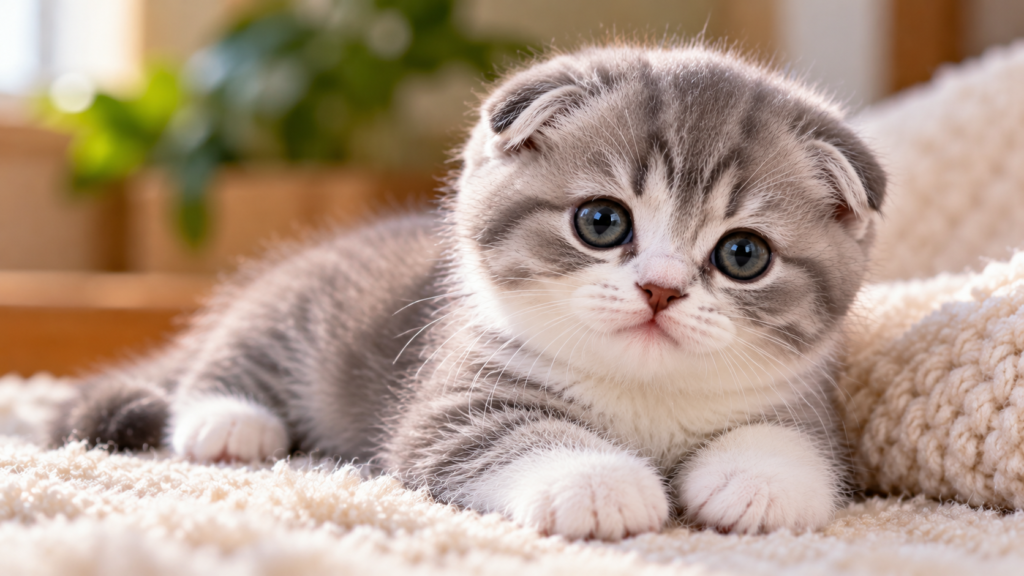
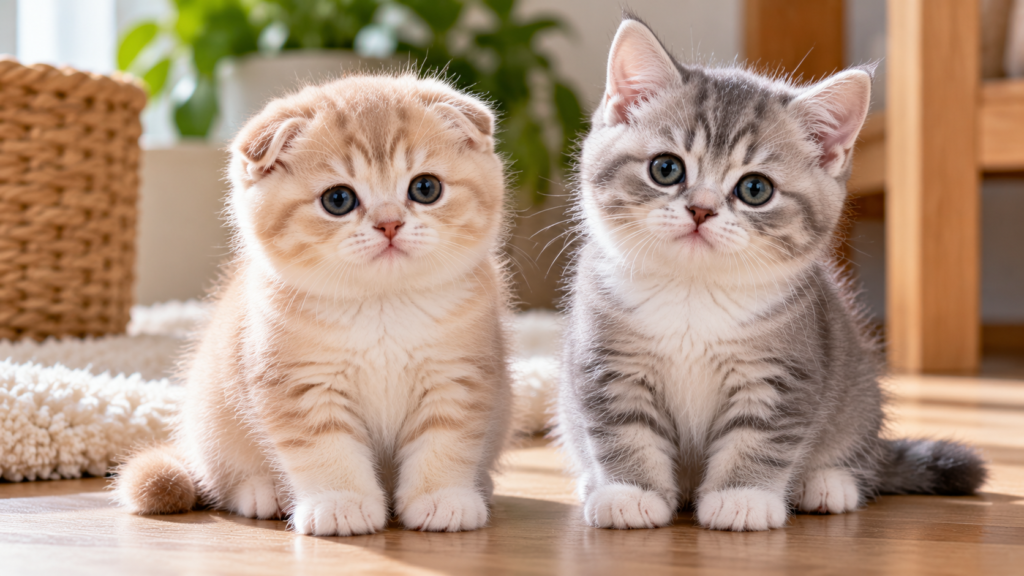
Scottish Fold kitten ears can be folded or straight even within the same litter. The folded appearance depends on a particular inherited genetic variant. A kitten that does not inherit this variant remains straight-eared and is commonly called a Scottish Straight.
Scottish Fold kitten ears that stay upright are therefore not automatically a sign of delayed development. A Scottish Straight is not a failed Scottish Fold. The two types can share similar round faces, coats, and personalities while differing in ear shape.
| Feature | Scottish Fold | Scottish Straight |
|---|---|---|
| Ears at birth | No characteristic fold | No characteristic fold |
| Typical appearance from weeks 3 to 4 | Forward folding begins | Ears remain upright |
| Later ear position | Folded to varying degrees | Straight |
| Fold-associated TRPV4 variant | Present | Absent in a genetically confirmed Scottish Straight |
| Other features | Rounded breed-group appearance | Similar general breed-group appearance |
You may read that about half of a litter will have folded ears. That figure describes the expected chance for each kitten in a common one-copy-fold-parent and noncarrier pairing, not a promise that exactly half of every litter will fold. Small litters can have different outcomes.
If you are unsure whether a kitten is a Fold or Straight, the kitten’s documented parentage and, where appropriate, veterinary discussion of genetic testing are more informative than trying to force a label based on a single photo.
What the Different Fold Shapes Look Like
Not every folded ear has the same appearance. Terms such as single fold, double fold, and triple fold are sometimes used in breed descriptions to talk about how closely the ears sit against the head.
A loose fold creates a noticeable forward bend, while a tighter fold can make the ears appear smaller and the head more rounded. These are appearance terms rather than distinct stages that every kitten must pass through.
Scottish Fold kitten ears should not be expected to progress from a single fold to a triple fold on a weekly schedule. A kitten may simply have a looser or tighter-looking fold. Nor can the visible depth of a fold, on its own, tell you the cat’s overall health.
A photograph taken from above may make ears look flatter than a photograph at eye level. When comparing Scottish Fold kitten ears in images, account for lighting, fur, and head angle.
The Genetics Behind Scottish Fold Kitten Ears
The Scottish Fold’s forward ear shape is associated with a variant of the TRPV4 gene, which affects cartilage. The UC Davis Veterinary Genetics Laboratory confirms that one copy of the fold-associated variant is sufficient for the characteristic folded-ear appearance, and that kittens without the variant have straight ears.
This background matters because the variant is also associated with cartilage and skeletal concerns elsewhere in the body. That is part of the established welfare discussion surrounding the breed. It would be inaccurate to present Scottish Fold kitten ears as a feature that has no connection with the rest of the cat’s anatomy.
At the same time, the appearance of the ears does not establish the condition of an individual kitten’s joints or bones. The degree of folding is not a home test for skeletal health. Questions about an individual kitten’s health or genetic status belong with a veterinarian.
Our Scottish Fold Health and Care guide provides broader background on the breed’s wellbeing without assuming that all cats have identical experiences.
Can Scottish Fold Ears Become More Upright Later?
Yes, the position of a folded ear can look more upright later in a cat’s life. Owners sometimes describe this as ears “unfolding.” A looser-looking ear does not mean the kitten has turned into a Scottish Straight, because its inherited genetics have not changed.
Scottish Fold kitten ears may also look different between photographs taken only a short time apart. A change in camera angle can exaggerate small differences, so pictures alone cannot show whether the cartilage structure has changed.
Do not tape, massage, bend, or press the ears to make them fold more closely. There is no safe reason to try to create the inherited ear shape by hand. If an ear suddenly changes position along with redness, discharge, swelling, head shaking, or apparent discomfort, contact a veterinarian rather than assuming it is ordinary development.
Watching Ear Changes Without Interfering
For owners documenting Scottish Fold kitten ears over time, a few clear photographs are enough. You can take one from the front and another from the side at approximately the same distance every week or two. Use the kitten’s actual age rather than an estimate whenever possible.
This creates a simple visual record of Scottish Fold kitten ears without handling them unnecessarily. There is no need to stretch the ears, inspect their folds with pressure, or compare the kitten with edited photos on social media.
Ear changes are only one part of early kittenhood. Feeding, sleeping, play, and supervision also change as kittens grow. Our Scottish Fold Kittens guide covers these wider development topics, while our article about leaving Scottish Folds alone includes a separate section on why kittens need more frequent attention than adults.
For general cat feeding information across life stages, the PetsMastery cat feeding guide discusses how kitten feeding needs differ from those of adult cats. It is a general care reference, not the source for the ear-folding timeline or genetic explanation.
Scottish Fold Ear Development at a Glance
| Owner’s question | Short answer |
|---|---|
| Are the ears folded at birth? | No, the characteristic forward fold appears later |
| When does folding usually start? | Around 3 to 4 weeks, sometimes first visible at 18 to 24 days |
| Is it unusual to see straight ears at 3 weeks? | No, the appearance can still be subtle |
| What if the ears remain straight? | The kitten may be a Scottish Straight |
| Do all folded ears look equally tight? | No, fold depth varies |
| Can the ears look more upright later? | Yes, the visible position can change |
| Can ear appearance confirm a kitten’s health? | No |
Frequently Asked Questions
Are Scottish Fold kittens born with folded ears?
No. Scottish Fold kitten ears do not have the characteristic forward fold at birth. The visible fold usually begins around three to four weeks in kittens carrying the relevant genetic variant. Straight-eared siblings do not develop this inherited fold.
Why are my Scottish Fold kitten’s ears still straight at 3 weeks?
Three weeks falls near the beginning of the usual folding window, so the appearance may not be clear yet. Some kittens have only a subtle forward bend at that age. Others are Scottish Straights and will retain upright ears. One photograph cannot reliably establish which explanation applies.
What if my Scottish Fold kitten’s ears are not folding at 4 weeks?
Scottish Fold kitten ears that remain upright at four weeks may belong to a Scottish Straight. Do not assume that the ears need help folding or try to reshape them. If you need to confirm the kitten’s ear type, ask about parentage and discuss any relevant questions with a veterinarian.
Can Scottish Fold ears start folding after 8 weeks?
The characteristic fold generally starts much earlier, around three to four weeks. A first fold beginning at eight weeks would fall outside the usual timeline. Sometimes an existing loose fold looks more noticeable later, which is different from saying the fold first developed at that age.
Do all kittens in a Scottish Fold litter have folded ears?
No. Folded-ear and straight-eared kittens can occur in the same litter. Which ear type a kitten develops depends on whether it inherits the fold-associated variant. A commonly quoted 50% chance applies to each kitten in a specific genetic pairing, not necessarily to the exact number of kittens in a litter.
Can Scottish Fold kitten ears unfold as the cat grows?
The visible position of Scottish Fold kitten ears may become more upright-looking over time. That does not remove the inherited variant. Ear position is also affected by how a cat holds its head and how a photo is taken, so appearance alone cannot explain every difference.
Are tighter ear folds a sign that a kitten is healthier?
No. The visual tightness of the fold cannot confirm a kitten’s overall health or rule out breed-associated concerns. Scottish Fold kitten ears are a visible breed characteristic, not a reliable at-home measure of joint or skeletal condition.
Final Thoughts
Scottish Fold kitten ears usually begin folding around three to four weeks, with early changes sometimes visible between 18 and 24 days. The characteristic fold in Scottish Fold kitten ears is not present at birth, and some littermates keep straight ears because they do not inherit the fold-associated variant.
The week-by-week timeline gives owners a useful reference, but it is not a deadline every kitten must meet. Loose folds, upright ears, and changes in how the ears look in photos should be described carefully rather than treated as diagnoses.
Watch your kitten’s natural development, avoid physically shaping the ears, and speak with a veterinarian about anything that appears uncomfortable or unusual. The most reliable answer comes from the kitten’s age, background, and individual circumstances, not a single photograph.