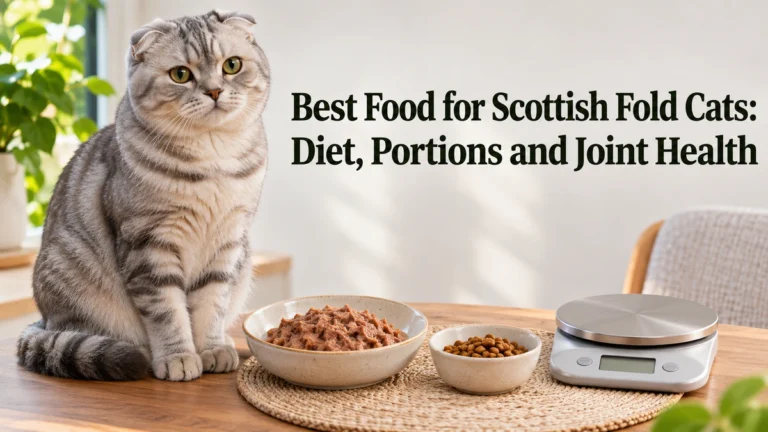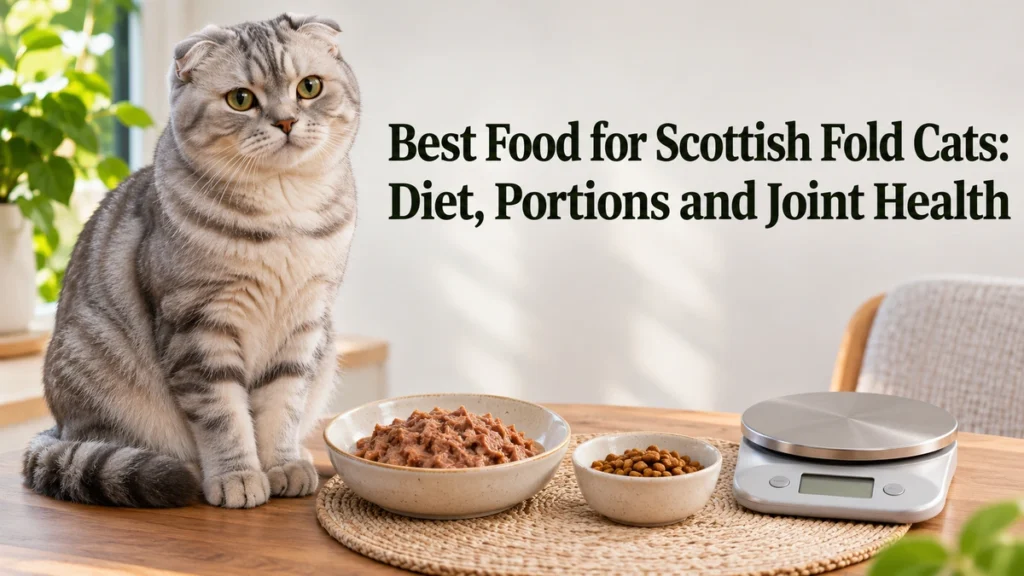


The best food for Scottish Fold cats is a complete, balanced adult diet that provides essential nutrients, supports a healthy weight, and suits the cat’s appetite and health needs. Wet food, dry food, or measured portions of both can work, but extra calories matter when painful joints make movement harder and weight starts to creep up. Start with the adult maintenance statement on the label, then check calories, offer fresh water, and ask your vet about joint support rather than expecting a special food to repair the breed’s cartilage condition.
Answer Box
The best food for Scottish Fold cats meets adult maintenance needs, fits their calorie allowance, and is eaten reliably. Choose complete wet food, dry food, or measured amounts of both. Provide water, keep treats below 10% of daily calories, and track body condition. Discuss joint supplements with your vet rather than adding them automatically.
Complete Adult Nutrition and Food Labels
Animal-Source Nutrients and Adult Maintenance
If you’re wondering “what do Scottish Fold cats eat,” start with their need for animal-source nutrients. Cats need protein, suitable fats, vitamins and minerals in balance. Dog food and improvised vegetarian meals cannot replace complete cat food.
Look for a nutritional adequacy statement saying the food is complete and balanced for adult maintenance. AAFCO sets nutrient profiles and feeding-trial standards; it does not approve, certify or test individual products.
A named animal ingredient is useful information, but being first on the list does not prove the whole recipe is balanced. Plain chicken alone is not a complete diet.
Random Fact 1: Taurine is essential for heart and eye health because cats cannot make enough themselves.
Labels That Matter More Than Marketing
The AAFCO adult protein minimum is 26% on a dry-matter basis, meaning after removing water. It is not a special Fold target, and a universal 40–50% requirement is not established for this breed.
Product names also matter. “Chicken Cat Food” generally follows the 95% rule, excluding processing water; “Chicken Dinner” follows the 25% rule. “With Chicken” can mean just 3%. These describe ingredients, not overall quality.
The best food for Scottish Fold cats should also have clear calorie information and a manufacturer that can answer nutrition questions. Premium and grain-free wording alone cannot settle the choice.
Wet, Dry and Mixed Feeding Compared
Wet Food and Water Intake
The best wet food for Scottish Fold cats is complete adult food your cat accepts and tolerates. Wet food commonly contains around 70–80% moisture, compared with roughly 10% in dry food, so it contributes more water with each meal.
Making wet food part of the daily menu can help water intake. There is no fixed wet-food percentage every Fold must eat. A complementary pouch or topper cannot serve as the whole diet.
Pate and chunks are texture choices. Gravy does not automatically make a food more suitable for adults.
Dry Food and Measured Mixed Meals
The best dry food for Scottish Fold cats also needs an adult adequacy statement. It can be practical and balanced, but small scoops may contain more calories than expected. Ordinary kibble does not replace tooth brushing or veterinary dental care.
| Food format | Main advantage | Main limitation | Portion check |
|---|---|---|---|
| Complete wet | Adds water | Open food needs safe storage | Calories per can or pouch |
| Complete dry | Easy to store and measure | Easy to overpour | Calories per gram |
| Measured mixed | Offers both formats | Two foods complicate totals | Add both calorie amounts |
Choosing the best food for Scottish Fold cats can include both formats, sharing one calorie budget.
Random Fact 2: Moisture differences can make wet food look lower in protein until both foods are compared on a dry-matter basis.
Daily Calories and Measured Portions
Calorie Ranges as a Starting Point
The answer to “how much should a Scottish Fold cat eat” depends on body condition, activity, neuter status and health. Some adults may start around 200–300 calories daily, but others need less or more.
A food label provides a starting suggestion. Check the cat’s response rather than assuming every label overestimates needs by a fixed percentage. The best food for Scottish Fold cats still needs a suitable portion.
The AAHA Energy Estimate
A commonly used starting calculation is:
RER = 70 × body weight in kilograms raised to 0.75
RER means resting energy requirement. Daily maintenance needs are estimated by multiplying RER by a suitable factor.
For a healthy, neutered adult, AAHA lists a factor of roughly 1.2–1.4. An inactive or obesity-prone cat may need around 1.0 instead. These are estimates, not home weight-loss instructions.
For example, a healthy 4 kg adult has an RER of about 198 calories. Multiplying by 1.2–1.4 gives approximately 238–277 calories daily. A vet should help set the target for an overweight, underweight or unwell cat.
Label Calories Converted Into Grams
First subtract treats from the daily target:
Food calories = daily target minus treat calories
Grams of food = allocated calories divided by calories per gram
| Illustrative daily target | Treat calories | Calories left for complete food |
|---|---|---|
| 240 kcal | 15 kcal | 225 kcal |
This is a calculation example, not a breed feeding chart. Suppose a hypothetical wet food provides 1 calorie per gram and a dry food provides 4. Giving 100 g wet supplies 100 calories; the remaining 125 calories would allow about 31 g dry.
Use your actual labels. Cups and can sizes do not have universal calorie values. Weigh portions with a kitchen scale rather than copying another owner’s bowl.
Track weight and body condition, then review the allowance with your vet. When mixing foods, never give a full daily serving of each. Include food used in puzzle toys and training in the same total.

Meal Timing, Treats and Gradual Food Changes
Two or Three Measured Meals
If “how often should I feed my Scottish Fold cat” is your main concern, two measured meals are a practical start. Morning and evening, roughly 12 hours apart, may fit your day. Three smaller meals are also reasonable.
This Scottish Fold feeding guide uses a measured daily allowance rather than unlimited refills. Separate feeding spaces help when another pet steals food. A timed feeder can divide a weighed allowance without increasing it.
Even the best food for Scottish Fold cats can lead to weight gain when the bowl is constantly topped up.
Treat Calories and a Slow Transition
Keep treats below 10% of daily calories and subtract them from the allowance. Fish oil, toppers and food used for medication count too. Using part of the measured food allowance as a reward keeps tracking simple.
Random Fact 3: Ten small treats can supply more calories than one larger treat; the label matters more than the count.
Change foods over roughly 7–10 days. Start with about 75% old food and 25% new, then move through 50/50 and 25/75 before offering only the new food. Spread these stages across several days.
Sensitive cats may need 7–14 days or longer, with veterinary guidance. Monitor appetite, stool and vomiting. Slow down if tolerance changes, and seek advice if problems persist.
Never withhold food to force acceptance. Offer an accepted food and contact your vet if intake falls. A cat refusing meals needs attention, not a stricter transition schedule.
Healthy Weight and Comfortable Joints
Weight Control With the Fold’s Cartilage Condition
The best food for Scottish Fold cats supports a lean, well-muscled body, but it cannot cure osteochondrodysplasia. This inherited cartilage and bone disorder is linked to the folded-ear gene. All folded-ear cats carry the affected trait, while joint changes and discomfort vary. Healthy weight and early veterinary care matter throughout adult life.
Body Condition, Muscle and Accessible Meals
Scottish Fold weight management starts with body condition, not a breed weight copied from a chart. A common target is 4–5 on a nine-point body-condition scale. Ask your vet to assess muscle as well as fat.
You should usually be able to feel the ribs beneath a light covering and see a waist from above. A dense coat can hide changes, so use gentle checks and regular weigh-ins.
Pain can reduce movement. Lower activity can then encourage weight gain, adding to the difficulty of moving comfortably. Measured portions and suitable activity help address that cycle together.
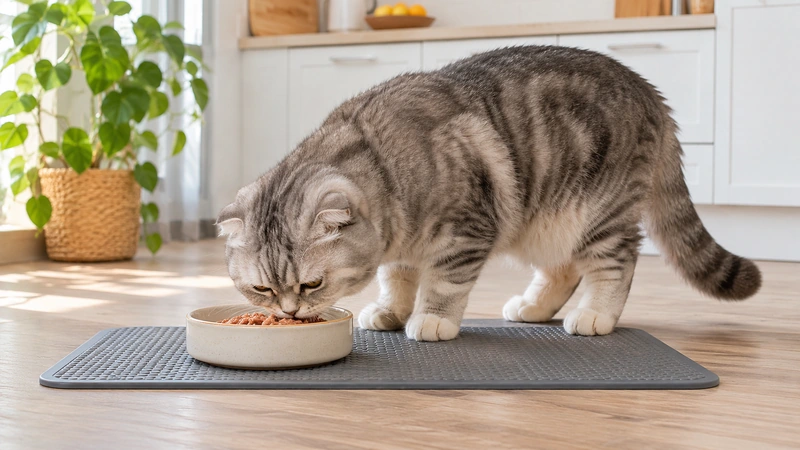
Offer gentle floor-level play without forcing jumps or chasing a tired cat. Put stable bowls on a nonslip surface where they are easy to reach. Let comfort guide bowl position.
A stiff tail, altered walk or reduced jumping deserves assessment rather than a supplement trial. Your vet can decide whether imaging and pain treatment are needed. Care may be ongoing.
Avoid crash diets, fasting and sudden large cuts. An overweight cat needs a planned calorie reduction with enough essential nutrients, followed by checks of progress and muscle condition.
Omega-3, Coat Care and Joint Supplements
EPA and DHA With Veterinary Guidance
When comparing the best food for Scottish Fold cats, check whether it already supplies EPA and DHA. These omega-3 fats, commonly from marine sources, have encouraging joint-support evidence, although cat-specific research remains limited.
Cats convert plant ALA, such as flaxseed oil, poorly into EPA and DHA. Total “fish oil” milligrams do not equal the amount of those active fats. Ask your vet about the complete diet, product content, added calories and an appropriate dose.
A dull coat or extra fur on the sofa does not prove a deficiency. Our Scottish Fold shedding and grooming article covers coat checks and routine brushing.
Limits of Glucosamine, Chondroitin and Other Additions
Evidence for glucosamine and chondroitin in cats is thin and inconsistent; neither guarantees pain relief or cartilage repair. Green-lipped mussel is another optional ingredient, not an essential addition.
Undenatured type II collagen, often called UC-II, has emerging feline evidence. A small controlled study reported improved owner-rated mobility and discomfort at six and twelve weeks. That supports further discussion, not a claim that it is the strongest treatment or a Fold-specific cure.
Discuss Scottish Fold joint supplements within a plan covering weight, home access and prescribed pain care. Complete diets usually need no extra nutrients. Avoid stacking supplements or replacing medication with them.
Unsafe Foods and Unnecessary Supplements
Household Foods to Keep Away
The list of foods Scottish Fold cats should avoid starts with onions, garlic, chives and leeks. These can damage red blood cells and cause anemia, including when cooked or powdered. Check sauces, broths and leftovers.
Chocolate and caffeine contain harmful stimulants. Alcohol and raw yeast dough are unsafe, while bones can cause choking, injury or blockage. Keep these away rather than guessing a safe serving.
Do not offer grapes, raisins or xylitol-sweetened products. The well-established grape kidney-injury and xylitol low-blood-sugar warnings mainly concern dogs; equivalent outcomes are not established in cats. That is not a reason to share them. Ask a vet about any exposure.
Dairy intolerance is a separate issue: milk may cause diarrhea or other digestive upset. Raw meat and fish can carry germs, and raw fish alone is not balanced. Some raw fish also contain thiaminase, which breaks down vitamin B1.
After suspected poisoning, call your vet promptly. In the US, ASPCA Poison Control is available at 888-426-4435. Keep the packaging and estimated amount handy. Do not induce vomiting or try a home remedy.
Balanced Minerals Instead of Blanket Restrictions
Calcium belongs in a complete adult diet. Do not remove it or add calcium, salt or mineral powders without veterinary advice.
There is no universal low-sodium limit established for every Fold. Specific restrictions should match a diagnosed condition.
Random Fact 4: Adding minerals to balanced food can upset its nutrient balance rather than strengthen bones.
Feeding Problems and Veterinary Review
Changes That Need Prompt Attention
Call your vet if an adult cat eats nothing for 24 hours, or sooner if unwell. Seek advice about a marked reduction too; do not wait several days when illness, pain or vomiting is present.
Not eating and not drinking needs urgent assessment. Unexplained weight changes, repeated diarrhea or trouble using the bowl also deserve a check.
Poor intake can cause hepatic lipidosis, a serious liver disorder, especially in overweight cats. It can be fatal without treatment. Never force-feed at home. ISFM guidance calls for timely veterinary nutritional support, not waiting through prolonged refusal.
Three Feeding Mistakes
- Unmeasured extras: Adding kibble to a full wet-food allowance without counting both.
- Marketing-led choices: Relying on premium, grain-free or meat-first wording instead of nutritional adequacy.
- Supplement shortcuts: Replacing balanced food, weight management or veterinary pain care with a joint product.
Review the feeding plan when health or activity changes.

FAQs
Does an adult Scottish Fold need breed-specific cat food?
No. The best food for Scottish Fold cats meets adult nutritional needs and fits your cat. A breed picture does not prove a better diet. A medical condition may require a therapeutic food chosen with your vet.
Is wet food better than dry food for an adult Scottish Fold?
Wet food supplies more water, but complete dry food can meet adult needs. The best food for Scottish Fold cats may combine both. Choose food your cat accepts, provide water and count the calories together. Complementary wet food should not replace a complete daily diet.
Is 200–300 calories a day enough for every Scottish Fold?
No. It can be a starting range for some adults, but activity, body condition and health change requirements. Use the food’s calorie label and a veterinary target, then monitor the result. A smaller, inactive adult and a larger, active adult may need different amounts.
Does every Scottish Fold need a joint supplement?
No. Supplement needs depend on the existing diet, symptoms and veterinary plan. Some cats may benefit from selected support, but evidence differs between ingredients. No powder repairs the inherited cartilage problem. Comfortable surroundings, suitable weight and pain treatment remain central when joint disease affects daily life.
Can homemade meat or raw fish replace complete adult food?
No. Plain meat or fish does not provide every nutrient in the correct balance. Raw ingredients also bring infection risks. If home-prepared meals are necessary, ask your vet for a recipe developed by a veterinary nutrition specialist. Do not build the diet from online ingredient lists alone.
Choose the best food for Scottish Fold cats by nutritional adequacy, acceptance and measured portions. Keep water available, track body condition and seek help when eating or movement changes. Our Scottish Fold health and care pages offer more support for calm, consistent care at home.
Sources