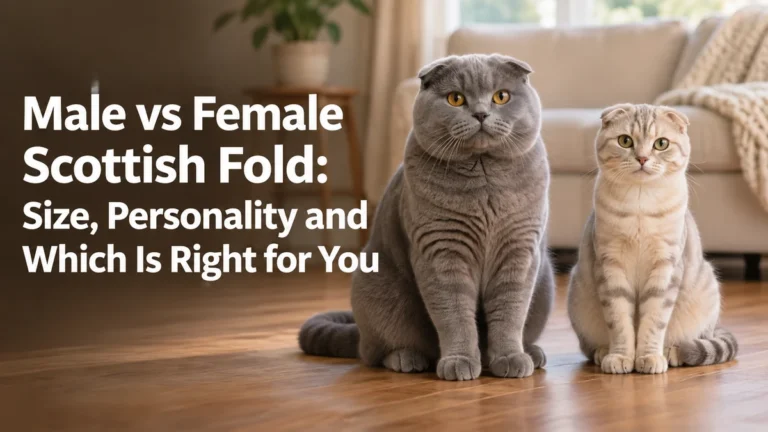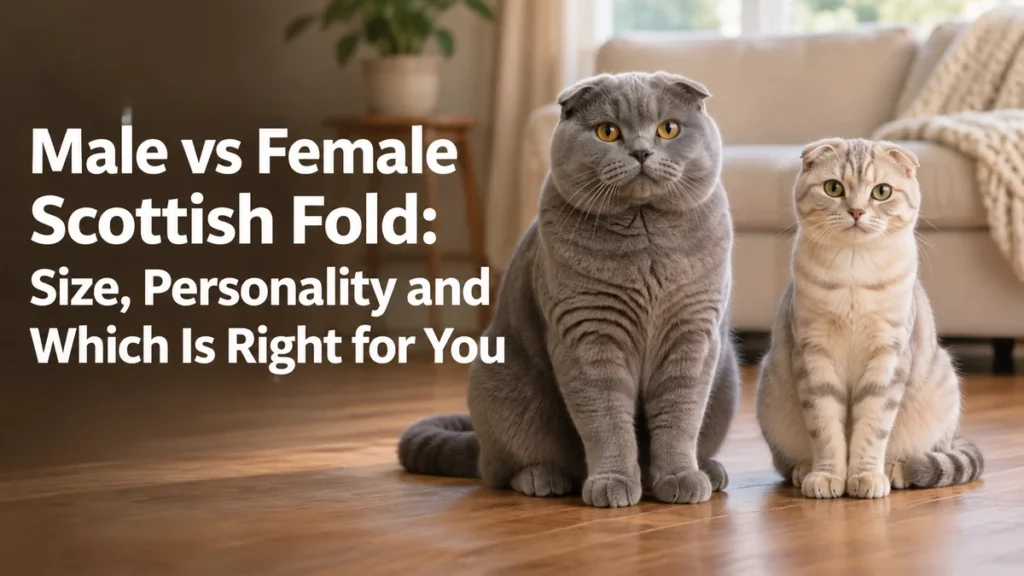


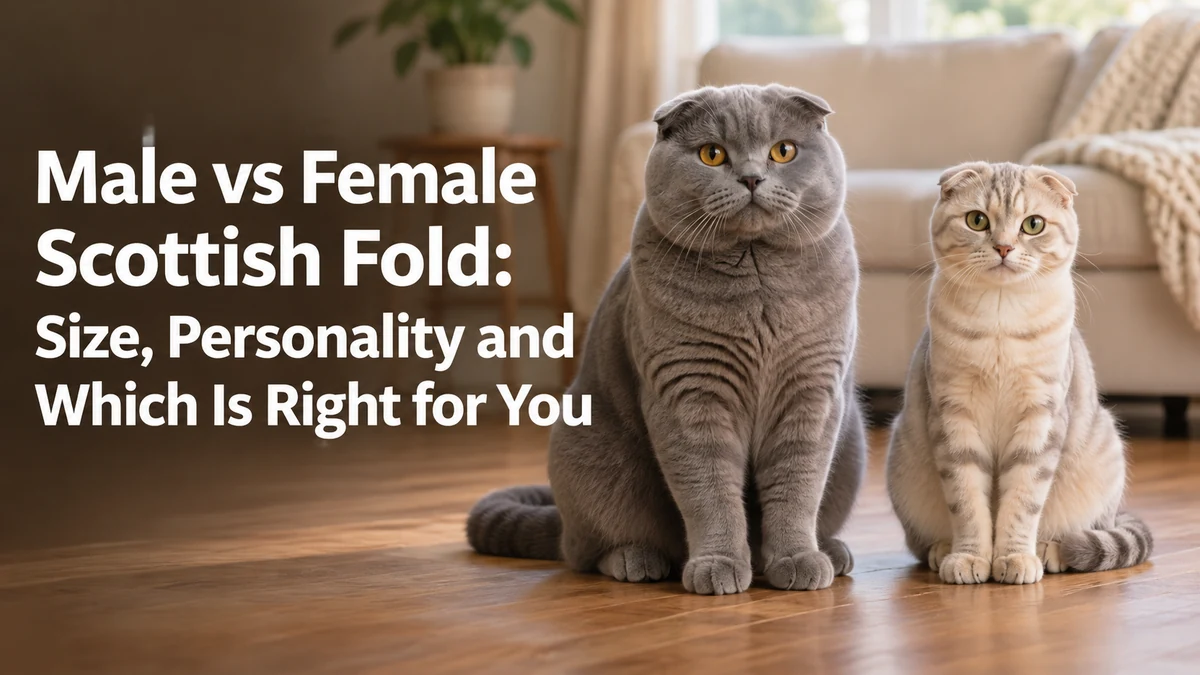
In a male vs female Scottish Fold comparison, males are usually larger, while either sex can be affectionate, playful and comfortable around familiar people when their needs are met. The Male Scottish vs Female Scottish choice becomes clearer when you consider the individual cat’s handling tolerance, early experiences and health alongside whether they have been spayed or neutered. Before choosing, spend time watching how the cat seeks company, responds to gentle play and settles after a surprise, then ask their caregiver about everyday habits and any ongoing veterinary care needs.
Quick comparison
Males tend to be heavier and broader, while females are usually smaller, with plenty of individual overlap. Both can enjoy company and gentle play. For the Male Scottish vs Female Scottish decision, look at personality, health and hormone status. A familiar caregiver’s observations can help you choose a cat whose needs suit your household well.
Male vs Female Scottish Fold Size at a Glance
Typical Adult Weight Ranges
Size is one of the clearest differences in the Male Scottish vs Female Scottish comparison. Adult males commonly weigh around 9–13 pounds, while females are often around 6–9 pounds.
For a Scottish Fold male vs female comparison, compare adults of similar age. A growing youngster and a fully grown cat can look very different.
| Comparison point | Male Scottish Fold | Female Scottish Fold |
|---|---|---|
| Typical adult weight | About 9–13 lb | About 6–9 lb |
| Approximate metric weight | About 4.1–5.9 kg | About 2.7–4.1 kg |
| Usual build | Larger and heavier overall | Smaller and lighter overall |
| Individual variation | Some males are smaller | Some females are larger |
| Healthy weight assessment | Consider frame and body condition | Consider frame and body condition |
Overlapping Sizes and Healthy Body Condition
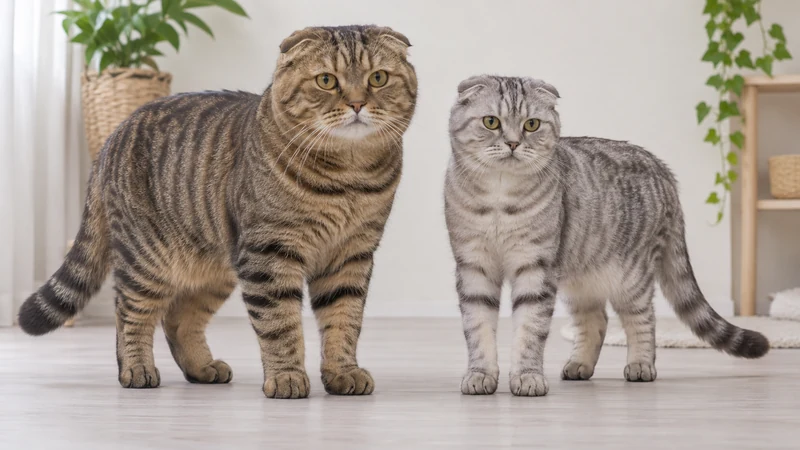
The male Scottish Fold weight range is a useful starting point. The female Scottish Fold weight range serves the same purpose. Neither gives you a feeding target for a particular pet.
When comparing male vs female Scottish Fold size, remember that excess fat can make a cat look larger. Your vet can assess body condition and suitable portions. Conflicting height and body-length figures online are less helpful than your own cat’s growth and condition.
Appearance, Coat and Visual Clues
Both sexes share the breed’s rounded look, but coat length can change their outline. A longhaired cat may have a neck ruff, fluffy tail and longer fur around the hindquarters. Grooming needs deserve a place in the Male Scottish vs Female Scottish decision.
Head Shape, Cheeks, Neck and Paws
Some adult males have broader heads, fuller cheeks, thicker necks and larger paws. Jowls can be especially noticeable in intact males. Females may look finer, though these features vary with age and body condition.
Coat Length and Color Patterns
Either sex can have a short or long coat. Patterns include solid, tabby, bicolor, calico, tortoiseshell and colorpoint. A fluffy outline or a particular color cannot confirm sex.
Random Facts
- Short and long coats occur in both sexes.
- Calico and tortoiseshell cats are almost always female, with rare male exceptions.
- Male and female adult weight ranges can overlap.
- Sex alone cannot tell you how cuddly a cat will be.
Personality Beyond Male and Female Labels
Common Male and Female Descriptions
Descriptions of male vs female Scottish Fold personality often make males sound outgoing and females sound independent. You may meet cats that fit those descriptions and others that reverse them. Treat the Male Scottish vs Female Scottish label as the beginning of your assessment.
Scottish Folds are often described as gentle, social and adaptable. Some enjoy laps, while others prefer a nearby cushion. A cat can bond closely with a person while wanting brief strokes instead of being carried around.
Socialization, Age, Health and Daily Experience
Ask what the cat does on an ordinary day. Visitor confidence, interest in play, comfort with touch and preference for company give you something concrete to consider. A cat that approaches quietly may enjoy people just as much as one that immediately climbs onto a lap.
Notice how the cat responds when contact pauses. They might lean toward a hand, settle beside you or leave. Their caregiver can describe whether that response is typical around visitors.
Early experiences and socialization help shape these responses. Present health matters too. Sudden withdrawal, less play or new discomfort with touch deserves a veterinary conversation. A change like that should not be dismissed as a female becoming reserved or a male getting lazy.
Affection, Cuddling and the Conflicting Advice
Breeder Observations About Cuddly Males
Some breeders report that males seek more open physical contact. BritishFolds describes this as personal experience and acknowledges plenty of exceptions. That observation helps explain why the idea appears so often in male vs female Scottish Fold discussions, but it cannot predict a particular cat’s preferences.
The Male Scottish vs Female Scottish affection debate needs this distinction between experience and evidence. One person’s affectionate male and independent female can both be real without establishing a rule for the breed.
The Limits of Sex as a Personality Predictor
González-Ramírez and Landero-Hernández surveyed 211 cat owners in Mexico for a 2022 paper in Animals. Owners of male cats reported higher emotional-closeness scores, but the researchers found no significant sex difference on the cat-owner interaction measure.
This was an owner-report study from one country, not a Scottish Fold experiment. It did not establish that males give more affection, or prove that males and females express it in particular ways. Cats Protection also emphasizes that either sex can be affectionate and that the individual cat’s background matters.
Observable Signs of a Good Match
Watch for contact the cat chooses. Following someone, resting in the same room, asking for strokes and sitting on a lap can all be welcome forms of company. Avoid assuming females only offer quiet proximity or that males always want to be held.
Ask the caregiver for examples from calm days at home. The cat might settle beside someone after play, enjoy a few strokes or seek quiet space.
Home Behavior, Spraying and Neutering
Marking and Roaming in Intact Males
Hormone status deserves attention in any male vs female Scottish Fold comparison. An intact male may seek mates, roam, compete with other males or mark with urine. These behaviors can influence the Male Scottish vs Female Scottish choice more directly than a general claim about cuddliness.
Spraying leaves a scent message, often on an upright surface. It differs from the larger amount of urine usually passed while squatting. Describe what you see if you ask your vet for help, because different house-soiling problems need different attention.
Heat Behavior in Unspayed Females
An unspayed female may call loudly, become restless and try to reach a mate while in heat. Females can also spray. Choosing a female therefore does not guarantee a home without marking, and choosing a male does not mean spraying is inevitable.
Changes After Spaying or Neutering
Neutering reduces the influence of reproductive hormones and often reduces mating-related marking and roaming. Spaying stops heat cycles. These changes do not guarantee a new personality, greater affection or an end to every marking habit.
Some behavior settles gradually over the weeks after surgery, while established marking or stress-related spraying may continue. Ask your vet about suitable surgery timing and what to expect for your cat.
Never punish spraying. Contact your vet about a new change, and describe recent moves, visitors or tension between pets. A calm response and a clear account of what happened are more useful than blaming the cat’s sex.
Shared Breed Health Risks and Lifespan
Cartilage, Joints and Osteoarthritis
For the Male Scottish vs Female Scottish decision, the inherited fold trait is a health concern in either sex. A variant in the TRPV4 gene affects cartilage development and causes osteochondrodysplasia. Every folded-ear Scottish Fold carries this concern, although visible signs and their severity vary.
Stiff tails, joint changes, limping and reluctance to jump can occur. There is no reliable age-by-age timetable that tells an owner when a particular cat will develop each sign. Ask a vet about new movement changes rather than waiting for an expected stage.
There is no cure for the underlying genetic condition. Veterinary care focuses on comfort and individual needs, which may include prescribed pain relief and changes at home. Keep essentials accessible and avoid forcing painful movement. Reduced activity can also make weight management harder.
Heart Health and Individual Veterinary Care
Heart disease, including hypertrophic cardiomyopathy, and polycystic kidney disease also belong in a Fold’s health discussion. Ask about veterinary history and any recommended screening. A cat’s sex cannot replace that information or remove the inherited cartilage concern.
Lifespan Estimates and Their Limits
Breed guides give varying lifespan estimates, often around 11–15 years. An estimate cannot promise years of healthy life for a particular cat. Joint disease and other conditions can affect both comfort and longevity.
For male vs female Scottish Fold owners, ongoing care matters. There is no verified breed-specific basis here for promising one sex better health or longer life. Discuss individual needs with a vet.
Identifying a Male or Female Scottish Fold
Genital Shape and Relative Spacing
To understand how to tell if a Scottish Fold is male or female, look at genital shape and relative spacing. In a female, the genital opening looks like a vertical slit and sits closer to the anus. In a male, the opening looks rounder and sits farther away, with the scrotum between the openings.
Testicles can be hard to see in young kittens and are removed during neutering. Their absence therefore cannot confirm that an adult is female. The relative spacing of the openings remains useful after neutering, though a vet can help when it is difficult to judge.
Coat Clues and Veterinary Confirmation
Head shape, paw size and ear folding cannot settle the Male Scottish vs Female Scottish question. Calico or tortoiseshell coloring is a strong clue toward female, with rare male exceptions.
Fold kittens start with straight ears, and folding generally begins around three to four weeks. The guide to when Scottish Fold kittens’ ears fold explains that development. Ear shape does not identify sex.
Handle gently and briefly, supporting the body. Stop if the cat resists and let a vet confirm sex. As a rough guide in an adult cat, the gap is about 1 to 1.5 inches in a male and under 1 inch in a female — but the exact distance varies with the cat’s age and size, so treat it as approximate and let a vet confirm when uncertain. Keep an uncertain sex label provisional until checked.

Choosing a Cat for Your Household
Choosing a male or female Scottish Fold works best when you describe your household first. The Male Scottish vs Female Scottish decision then becomes a match between the cat’s observed needs and the care you can provide.
Families and Children
Look for comfort around gentle handling, confidence and the ability to settle after an ordinary surprise. Children need supervision and clear boundaries. Give the cat a quiet retreat and allow them to leave an interaction. A small female can need as much personal space as a larger male.
Other Cats and Dogs
Ask about previous experience with pets, including what introductions involved and how the cat behaved afterward. Neither a male/female pairing nor a neutered male guarantees compatibility. Plan gradual introductions and enough space for each animal to feel secure.
First-Time Owners and Everyday Care
An adult shelter cat can be a useful choice because caregivers may know their established habits. Ask what ongoing care involves and whether you can manage it. With Scottish Folds, that includes understanding the genetic joint concern and budgeting for veterinary support.
| Household | What to assess | What to ask the caregiver |
|---|---|---|
| Children | Gentle contact and a safe retreat | How does the cat respond around children? |
| Another cat | Previous shared living and separate space | Has this cat lived comfortably with others? |
| A dog | Experience with calm dogs | What helped earlier introductions? |
| Quiet home | Preferred play and company | When does the cat usually seek contact? |
| First-time owner | Daily routine and health needs | What support and veterinary care are ongoing? |
Three common mistakes
- Choosing a male solely because males are said to be cuddlier. Ask for examples of the cat’s usual behavior.
- Confirming sex from cheeks, paws or folded ears. Get a proper check when uncertain.
- Assuming either sex avoids joint problems or automatically welcomes other pets. Review health needs and introduction plans.
For more everyday breed topics, visit the Breed & Personality archive.

Frequently Asked Questions
Are Male Scottish Folds More Affectionate Than Females?
Some breeders report cuddlier males, but there are many exceptions. In the Male Scottish vs Female Scottish comparison, an individual cat’s history and chosen contact are more helpful than a promise based on sex. Either can enjoy laps, nearby company or gentle strokes.
Can a Female Scottish Fold Be Bigger Than a Male?
Yes. Adult ranges overlap, and frame, age and body condition affect appearance. Compare cats at a similar life stage and ask your vet about a healthy weight for your own pet. A larger-looking cat may have more fur or excess body fat.
Do Female Scottish Folds Spray After Being Spayed?
They can. Spaying removes heat cycles but does not rule out marking related to stress or territory. A new spraying pattern deserves a veterinary conversation. Describe whether your cat stands against a surface or squats to pass urine, and mention changes at home.
Are Male or Female Scottish Folds Better With Children and Other Pets?
Either can suit a family when temperament, health and introductions fit. Ask about previous experience with children or animals. Supervise contact, teach gentle handling and provide retreat space. Existing comfort with pets is more useful than assuming one sex will accept every newcomer.
Do Male or Female Scottish Folds Live Longer?
The sources reviewed here do not establish a Scottish Fold-specific lifespan advantage for either sex. Broad breed estimates vary, and an individual cat’s genetic condition and other health needs matter. Ask about quality of life and ongoing care alongside the expected years.
The Male Scottish vs Female Scottish choice starts with knowing the individual. Use this male vs female Scottish Fold comparison to ask clear questions about temperament, hormone status and health, then choose a companion whose needs your household can meet.
Sources